
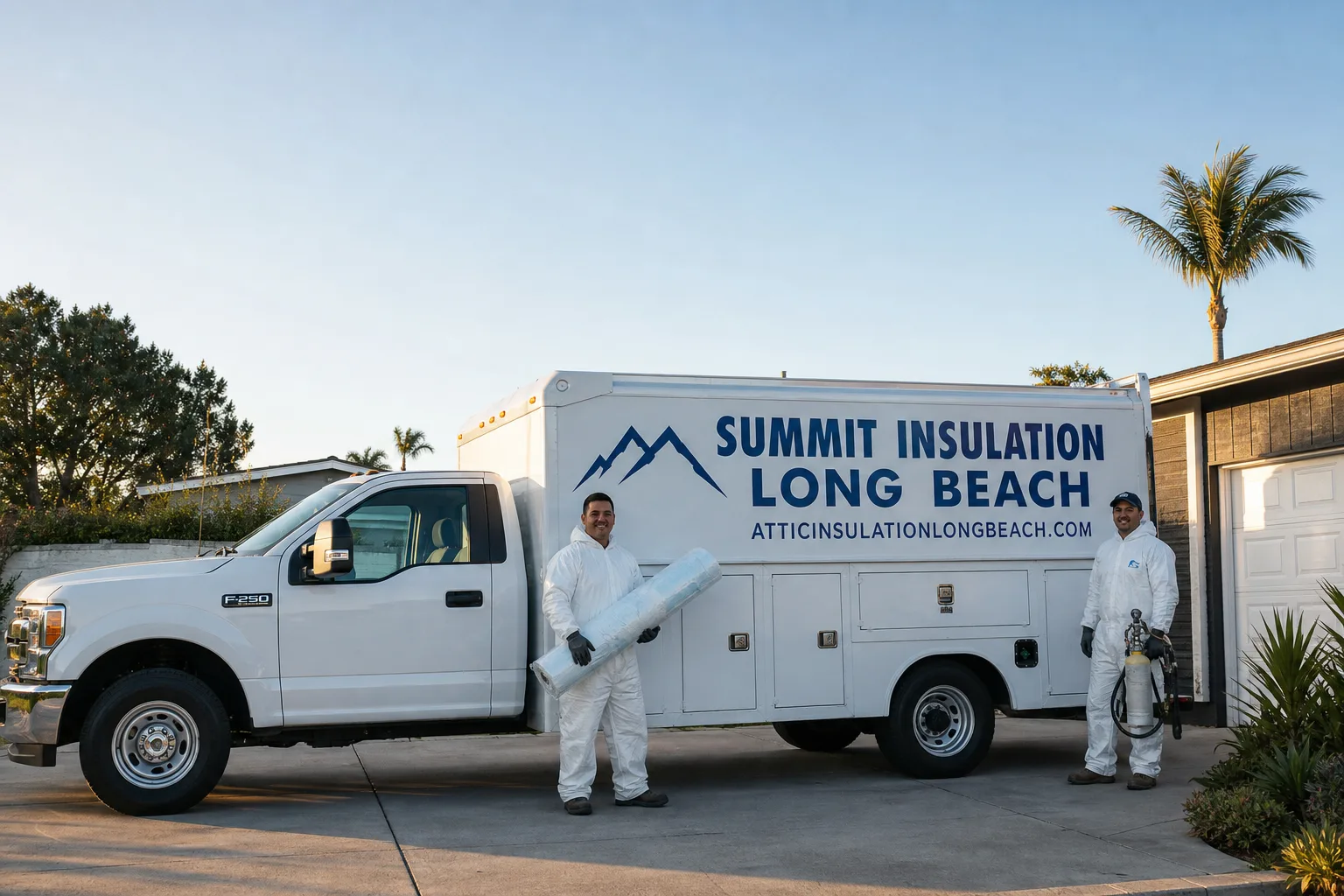
Trusted Spray Foam Insulation for Long Beach Homeowners
If you’re wondering how much Spray Foam Insulation costs, Long Beach prices typically run $2.50 to $7.50 per square foot installed, with open-cell foam on the lower end and closed-cell on the higher end. Most whole-attic jobs in Long Beach run between $3,800 and $9,200 depending on square footage, roof configuration, and whether old insulation needs removal first. Summit Insulation Long Beach is owner-operated, with Nate Calloway serving as lead installer on every project. Call (562) 784-9031 for a free estimate, and we’ll typically have someone at your door within 48 hours.
What Our Spray Foam Insulation Service Includes
Spray foam isn’t one product, it’s a family of materials with different densities, R-values, and ideal applications. We match the foam to the surface and the problem. Here’s what we install in Long Beach homes, including our Spray Foam Insulation in Long Beach, from crawl spaces to rooflines, and why each application matters.
Open-Cell Spray Foam
Open-cell foam is the workhorse for attic ceilings and interior walls in Long Beach. It expands to roughly 100 times its liquid volume, filling stud bays and rafter cavities completely, which makes it excellent for sound dampening and air sealing. At around R-3.7 per inch, it’s not the highest R-value material out there, but it’s the right choice when you need air movement stopped and you’re working in a ventilated attic. Long Beach homes built before 1980 often have gable vents and soffit vents that work fine with open-cell foam on the attic floor, and we install it with a thermal barrier code-compliant finish every time.
Closed-Cell Spray Foam
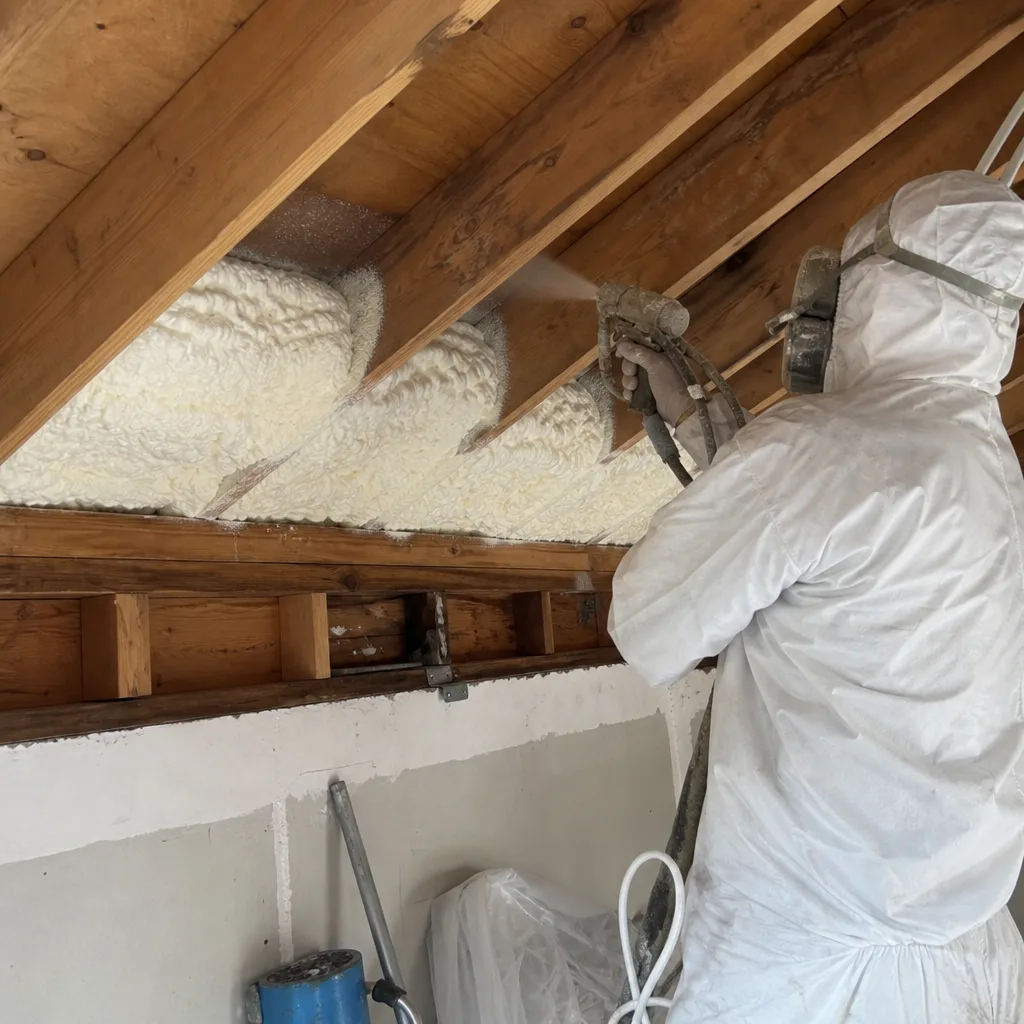
Closed-cell foam is denser, harder, and carries roughly R-6.5 to R-7 per inch, about double what open-cell delivers. It also acts as a Class II vapor retarder at 2 inches, which matters in Long Beach because our marine layer and summer humidity mean crawl spaces and rim joists stay damp for months. We specify closed-cell foam for rim joists, crawl space walls, and any application where moisture resistance is non-negotiable. It costs more per board foot, but when the application calls for structural strength and moisture control, it’s the only foam that does the job correctly.
Rim Joist Spray Foam
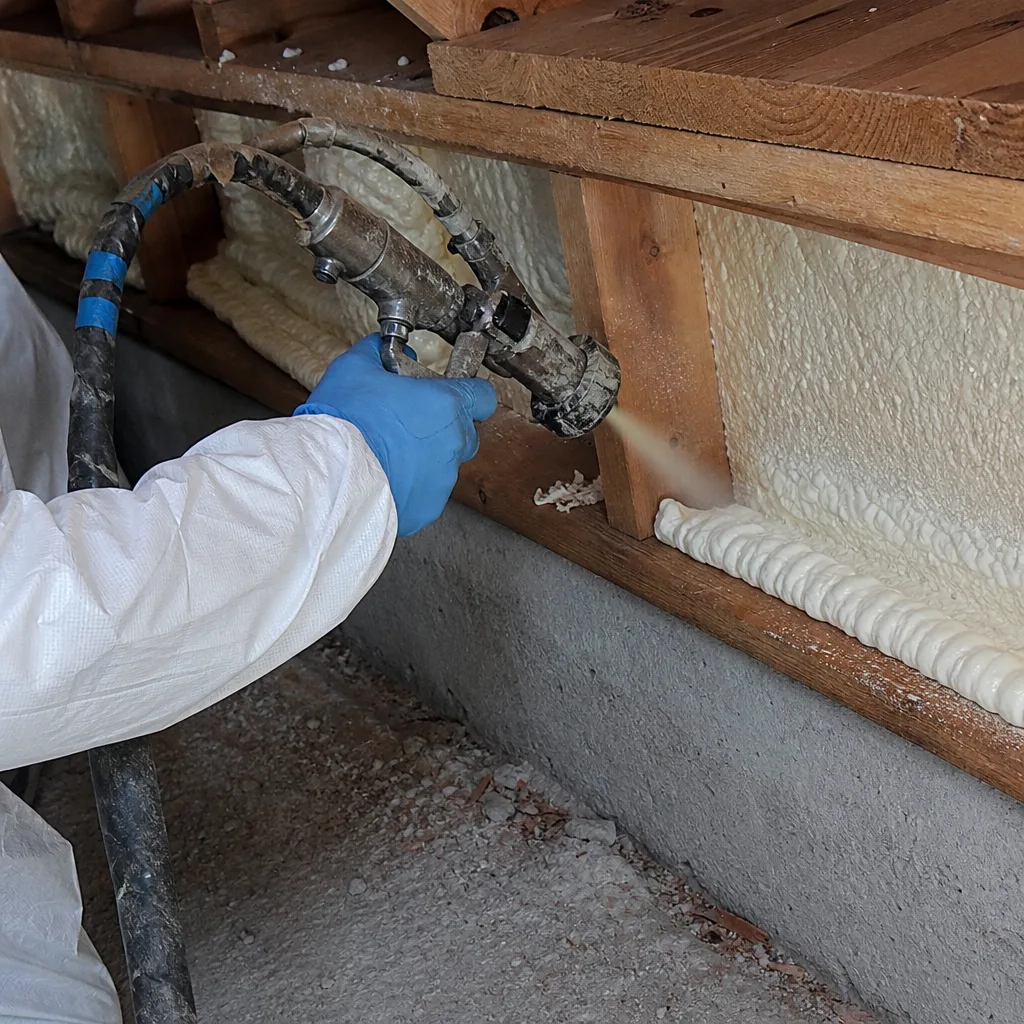
The rim joist, the band of framing where your floor meets your foundation, is the most overlooked air leak in a Long Beach home. Cold air, dust, and in some neighborhoods, rodent traffic enters here because fiberglass batts simply don’t seal the cavity. In homes near the Los Angeles River corridor, in Signal Hill Spray Foam Insulation areas, and in older neighborhoods like Wrigley and Cambodia Town, we routinely find rim joist gaps that account for 15 to 20 percent of total air infiltration. We spray closed-cell foam into each rim joist bay, which seals the gap, insulates the floor edge, and creates a moisture barrier in one application. Most rim joist jobs are done same-day.
Garage Ceiling Spray Foam
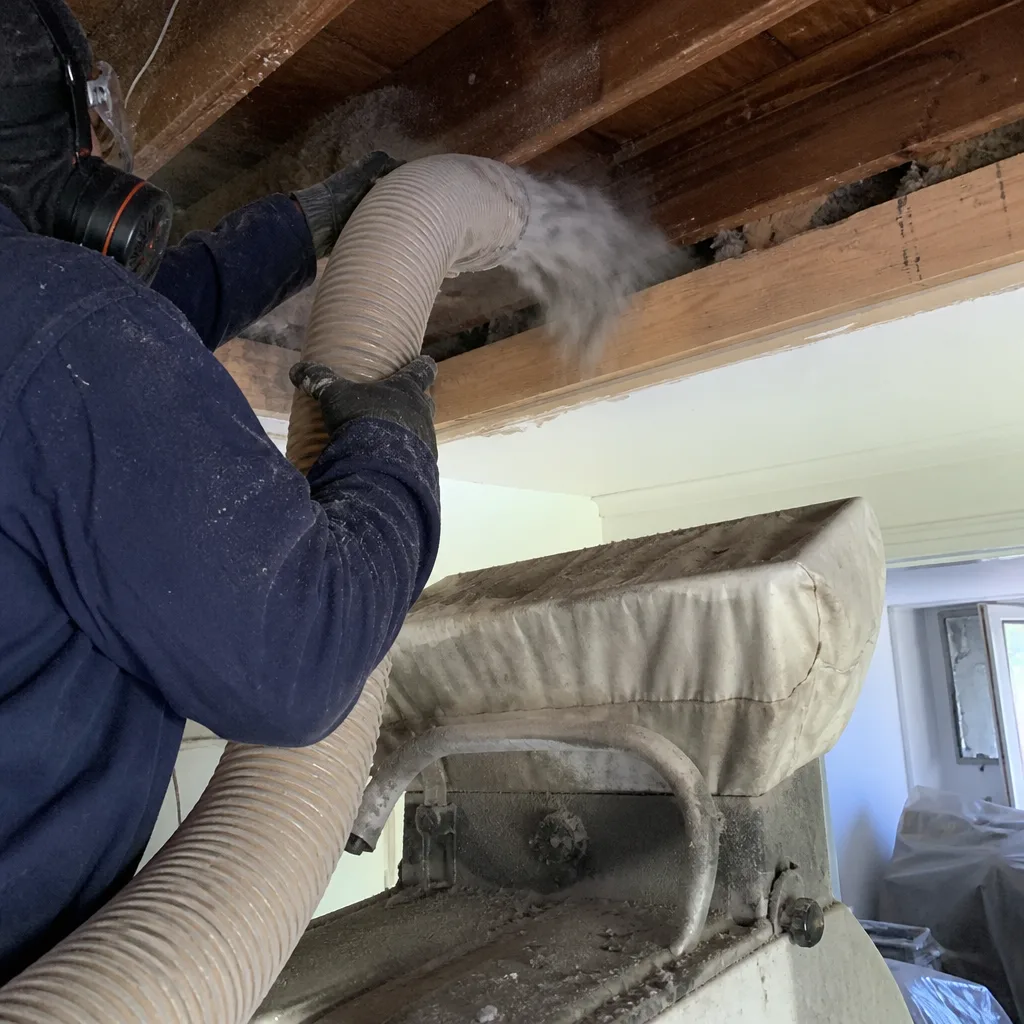
If you have a bedroom above your garage, or if your garage shares wall space with a living area, spray foam on the garage ceiling changes how that room feels. In Long Beach and nearby Carson Spray Foam Insulation areas, where attached garages collect afternoon heat off concrete driveways, garage ceilings radiate that heat upward into finished rooms. Open-cell foam applied to the garage ceiling and the shared wall slows that heat transfer dramatically. We also see homeowners choose garage ceiling foam when they’re converting a garage to a workshop or gym and need the space itself conditioned. Either way, we apply it directly to the drywall underside with full coverage to the perimeter, no gaps at the edges.
Spray Foam Roof Deck
Applying foam to the underside of the roof deck creates what’s called an unvented attic, and it’s a specific strategy for homes where ductwork runs through the attic or where attic temperatures are causing real problems. In Long Beach, homes with flat or low-slope roofs and very little attic ventilation are strong candidates, as are homes in Naples and Belmont Shore where shingle roofs and salt air combine to push attic temps past 140 degrees in August. We spray closed-cell foam directly to the roof deck, which keeps the attic within a few degrees of the living space. This is a technical application that requires a moisture assessment first, and we won’t recommend it unless your roof and climate actually support it.
What happens when you call
- 1
A real person answersNo phone trees — you reach a local pro.
- 2
You get an upfront price rangeHonest numbers before anyone is dispatched.
- 3
A background-checked tech heads outLicensed & insured, dispatched right away.
- 4
You approve before work beginsNothing starts until you say go.
Brands We Service for Spray Foam Insulation
Summit Insulation Long Beach installs spray foam from Icynene and Demilec, two manufacturers that have committed to third-party testing, environmental product declarations, and long-term performance data. These aren’t contractor-grade unknowns picked up at a supply house on a discount. We’ve installed both open-cell and closed-cell systems from each brand and we know their expansion rates, cure times, and material behaviors in Southern California’s specific humidity conditions.
The reason we carry two foam lines isn’t about volume, it’s about precision. Icynene’s open-cell formulations perform exceptionally well in ventilated attics and interior wall cavities where sound control matters as much as R-value. Demilec’s closed-cell products, including their Heatlok line, are our go-to for rim joists, crawl spaces, and roof decks where vapor drive and structural rigidity are factors. We’re not tied to one manufacturer’s engineering constraints, so the material decision gets made based on your home’s actual conditions, not on what’s in the truck. Whether your existing insulation is from these brands or any other, we can assess it during a home energy audit and make an honest recommendation.
We also stock Owens Corning and CertainTeed products for hybrid applications, which matters in scenarios where spray foam works best in combination with another material, like closed-cell foam on the roofline paired with blown-in fiberglass on the attic floor.
Signs You Need Spray Foam Insulation Right Now
- Your upstairs rooms run 8 to 10 degrees warmer than downstairs in summer. That’s a textbook sign of attic heat radiating through your ceiling, and Long Beach afternoons in July and August are brutal enough that your AC fights a losing battle. Spray foam on the attic floor or roof deck cuts that radiant load at the source, and we’ve seen homes in Los Altos and Plaza drop upstairs temps within a day of installation.
- Your energy bill spiked, and you can’t figure out why. Pacific Gas & Electric and Southern California Edison rates have risen every year since 2020, but a sudden jump usually points to air leakage. When conditioned air escapes through rim joists, wall cavities, and attic penetrations, your HVAC runs longer to maintain the same temperature. We find the leaks first, then seal them with foam where it’s the right tool.
- You feel a draft near your baseboards or electrical outlets on exterior walls. Walls that were insulated with fiberglass batts in the 1960s and 70s have settled, and Long Beach’s older housing stock in Dooley District and Rose Park has this problem everywhere. Spray foam installed into wall cavities reaches areas batts never touched, and it doesn’t settle or sag over time.
- You see moisture staining or condensation on the underside of your roof sheathing. That means warm, moist air is reaching the roof deck and condensing, which is a precursor to mold and, in extreme cases, dry rot of the sheathing. Closed-cell foam on the roof deck creates an air and vapor barrier that stops that moisture at the source. We would rather treat this early than quote you a roof replacement later.
- Your attic smells like rodents or you’ve seen droppings in the insulation. Insulation that’s been contaminated by pests needs removal before anything new goes in. We bundle attic cleaning and rodent proofing as a prerequisite to spray foam installation, because spraying new foam over a contaminated substrate just seals the problem in permanently. The foam itself deters future intrusion better than batt insulation, but only if the attic starts clean.
Our Spray Foam Insulation Process — Step by Step
Every spray foam job in Long Beach follows the same sequence, whether it’s a garage ceiling in Lakewood Village or a full roof deck in Belmont Park. Here’s how we work, and what you can expect on installation day.
- 1
Initial assessment and home energy audit. Before we quote anything, we walk your home and measure what’s actually happening. That means checking attic depth, rim joist condition, existing ventilation, moisture readings on the roof deck, and looking for air leaks with a blower door test where the home allows it. We don’t recommend spray foam unless the data supports it, and our audit reports show you exactly where heat enters and escapes. This step takes about an hour, and it’s included in your free estimate.
- 2
Material specification and scope confirmation. Once we know the problem, we specify the foam type, target R-value, application area, and whether any remediation or air sealing needs to happen first. If your attic has old, rodent-contaminated insulation, that removal gets scheduled before foam day. You’ll get a written scope with square footage, brand names, R-value targets, and a fixed price. No allowances, no change orders unless the scope actually changes.
- 3
Prep and protection. On installation day, we protect floors, seal off the work area, and establish ventilation. Spray foam application creates fumes during the curing process, so we use negative air pressure and containment where needed, and we keep you out of the space until the foam has off-gassed. This is standard procedure for us, not an upsell, and we’ll tell you exactly when you can safely re-enter.
- 4
Spray foam application. Nate Calloway runs the spray rig himself on every job. That means the person estimating your project is the same person applying the foam, which eliminates the disconnect where a salesperson promises one thing and a subcontracted crew delivers another. We apply foam in lifts, monitoring temperature and humidity throughout, because Long Beach’s coastal air affects how open-cell foam expands and cures. Rushing this step is how you get voids and shrinkage, and we don’t rush.
- 5
Inspection, cleanup, and verification. After the foam cures, we check coverage depth with a probe in multiple locations, confirm the R-value matches the spec, and remove all masking and protective material. We’ll walk you through the finished work, show you the problem areas before and after, and schedule a follow-up check in 30 days if the scope was large. If anything isn’t right, we fix it, and we’re the ones you call, not a customer service center.
How Much Does Spray Foam Insulation Cost in Long Beach?
A typical open-cell attic floor application in Long Beach runs $2.50 to $4.00 per square foot installed. Closed-cell foam runs $4.50 to $7.50 per square foot, with rim joist sealing usually falling between $900 and $2,200 for the average two-story home. A full spray foam roof deck for a 1,500-square-foot single-story home typically lands between $7,000 and $13,000 depending on the foam depth, roof access, and whether existing insulation is being removed. Attic cleaning and rodent proofing, when needed before foam, typically adds $1,200 to $3,500.
What drives the price in Long Beach specifically? Roof pitch and attic access are big factors, since a low-slope or flat roof makes the work physically harder. The age of your home matters too, because homes built before 1978 may have vermiculite or asbestos-containing materials that require specialized removal. The marine layer means we sometimes need to run dehumidifiers during large open-cell jobs in the spring and early summer, which adds a bit of labor time. You avoid overpaying by getting a fixed, written scope, and by choosing a contractor who specifies the foam type and R-value before they start. Our estimates are free, itemized, and good for 30 days. Call (562) 784-9031 and we’ll come out and measure it properly.
Spray Foam Insulation Near Long Beach — Our Service Area
Summit Insulation Long Beach serves Long Beach and the surrounding communities including Lakewood, Signal Hill, Bellflower, Carson, Artesia, Paramount, Cerritos, Commerce, Whittier, Compton, and Lynwood. We typically schedule estimates within 24 to 48 hours, and for smaller jobs like rim joist sealing or garage ceiling foam, we can often install within the same week. For larger whole-attic or roof deck projects, we’ll give you a firm installation window at the time of the quote. You can also check our home page for the full list of insulation services we provide across the Long Beach area.
Serving Long Beach, CA — Our Local Coverage Area
We’re based in the Long Beach area and know this community well. Use the map below to see our service coverage — if you’re nearby, we can almost certainly help.
Frequently Asked Questions — Spray Foam Insulation in Long Beach
Spray foam insulation is a two-part polyurethane mixture that’s applied as a liquid and expands on contact to fill cavities, cracks, and gaps in your home’s thermal envelope. It comes in two main forms: open-cell, which is lighter and more flexible, and closed-cell, which is denser and acts as a moisture barrier. Unlike fiberglass batts or blown-in cellulose, spray foam also air seals as it insulates, which is why it’s so effective at reducing drafts and energy loss in Long Beach homes. Summit Insulation Long Beach installs both types, matching the foam to your specific application.
Most rim joist and garage ceiling jobs in Long Beach are completed in a single day. Whole-attic open-cell applications typically take one to two days, while closed-cell roof deck projects can take two to three days depending on the square footage. Foam cures within 24 hours, and we’ll tell you exactly when you can safely re-enter during your free estimate.
Expect $2.50 to $4.00 per square foot for open-cell foam and $4.50 to $7.50 for closed-cell, with whole-attic projects ranging from $3,800 to $13,000 depending on scope and access. The best way to get an exact number is to call (562) 784-9031 and schedule a free assessment, because square footage alone doesn’t tell us what we’re working around.
Yes, we install both Icynene and Demilec spray foam products and we know their expansion characteristics, cure times, and ideal applications. If your home already has spray foam from either brand and it’s underperforming, we can assess it during a home energy audit and recommend the right fix. We’ll never push a brand that doesn’t fit your home’s actual conditions.
We can often schedule same-week visits for urgent issues like rim joist gaps, exposed wall cavities during remodeling, or failed foam that’s leaving a room uninhabitable. Call (562) 784-9031 in the morning and we’ll do our best to get someone out the same day. For non-urgent estimates, we’re typically at your door within 48 hours.
Our workmanship is guaranteed, and the materials we install carry manufacturer warranties from brands like Icynene and Demilec. We’ll explain exactly what’s covered and for how long before we start, and if something fails, you call Nate directly, not an answering service. We also document every job with photos and moisture readings for your records.
Clear the work area of stored items, move vehicles out of the garage if we’re spraying there, and plan to be out of the home or in an unaffected area during application and curing. We handle containment, floor protection, and ventilation, and we’ll walk you through a preparation checklist when you book. The goal is to make installation day uneventful for you.
Schedule Your Spray Foam Insulation Service in Long Beach Today
If your Long Beach home is bleeding conditioned air through old insulation, rim joists, or a hot attic, spray foam is often the highest-impact fix available. Nate Calloway will assess your home, explain your options in plain language, and install the right foam himself. Call (562) 784-9031 now for a free, no-obligation estimate, and let’s get your home’s thermal envelope sealed before the next heat wave.
Written by Nate Calloway, Owner and Lead Installer at Summit Insulation Long Beach, serving Long Beach homeowners since the company was founded.