
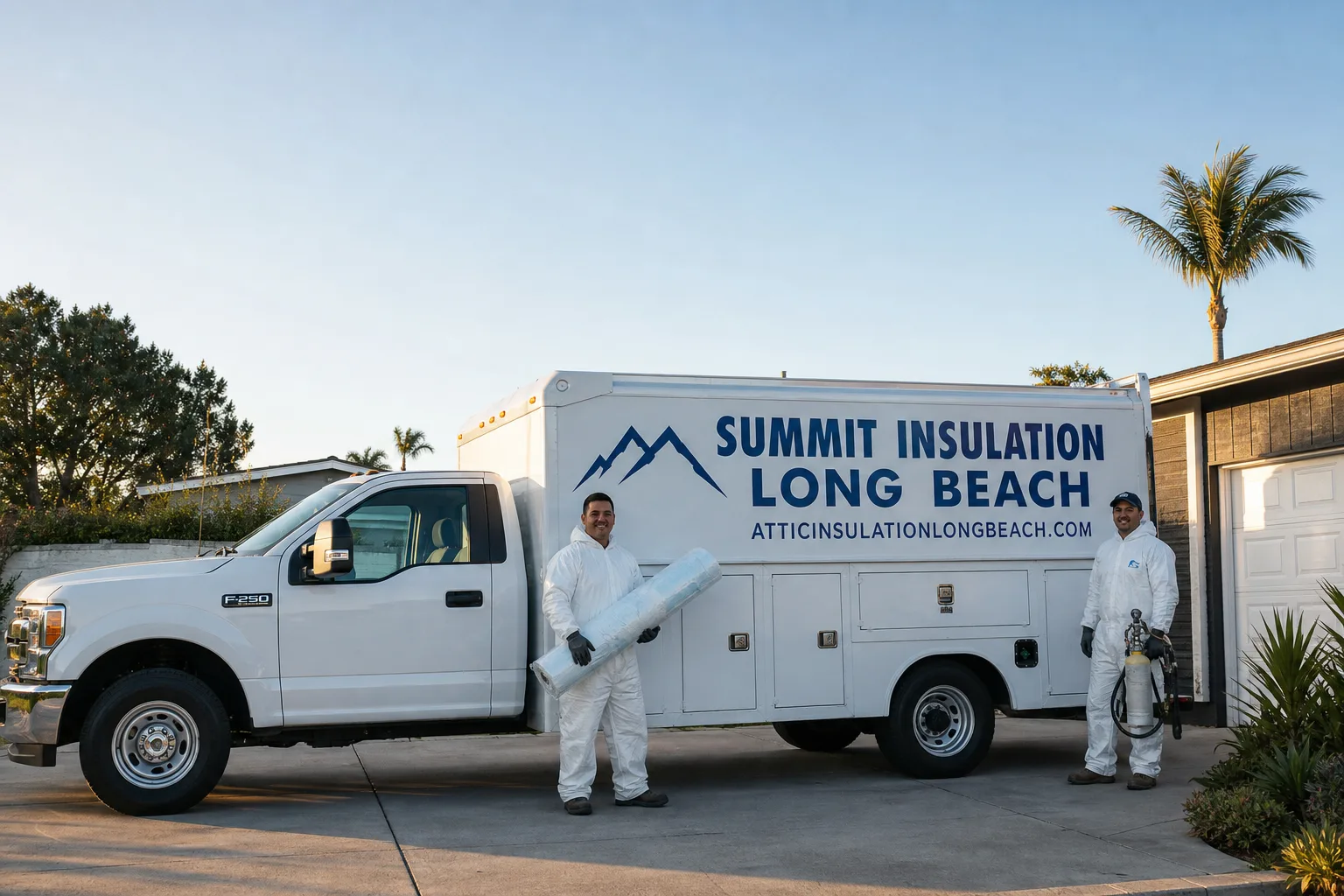
Trusted Blown-In Insulation for Long Beach Homeowners
Blown-in insulation in Long Beach costs between $1.80 and $4.10 per square foot installed, with most 1,200-square-foot attic jobs running $2,160 to $4,920 depending on existing conditions and the material you choose. That’s the range we work in at Summit Insulation Long Beach, and we can usually get a crew to your home within 48 hours of your first call. Nate Calloway owns this company and works as the lead installer on every job, so when you call (562) 784-9031, the person quoting the work is the same person doing the work.
We’ve spent years correcting bad insulation jobs around Long Beach. We see the same problems in Naples, Bixby Knolls, and the Wrigley district: thin attic coverage, fiberglass that’s turned gray from decades of dust and rodent traffic, and walls that were never insulated at all because the house predates California’s Title 24 energy code. Our Blown-In Insulation in Long Beach solves most of these problems in a single visit, and done right, it pays for itself through lower cooling costs. That’s the job, and it’s the only job we do.
Key Takeaways
- Blown-in insulation costs $1.80–$4.10 per square foot in Long Beach, with attic top-ups on the lower end and dense-pack wall work on the higher end.
- The owner, Nate Calloway, is the lead installer on every project — no subcontractor roulette when the crew shows up.
- We match the material to the application — cellulose or fiberglass in attics, dense-pack for walls — rather than defaulting to whatever’s cheapest.
- We’re local to Long Beach with quick response times for Lakewood, Signal Hill, Bellflower, and surrounding areas.
- Free estimates include a visual inspection and honest assessment of whether your existing insulation needs removal first.
What Our Blown-In Insulation Service Includes
Blown-in insulation isn’t one product — it’s a method, and the material matters. We carry both cellulose made by GreenFiber and fiberglass made by Owens Corning and Johns Manville. The right material depends on where it’s going, what your home’s framing looks like, and how much existing insulation is already in place. Here’s what each of our blown-in services covers.
Blown-In Cellulose
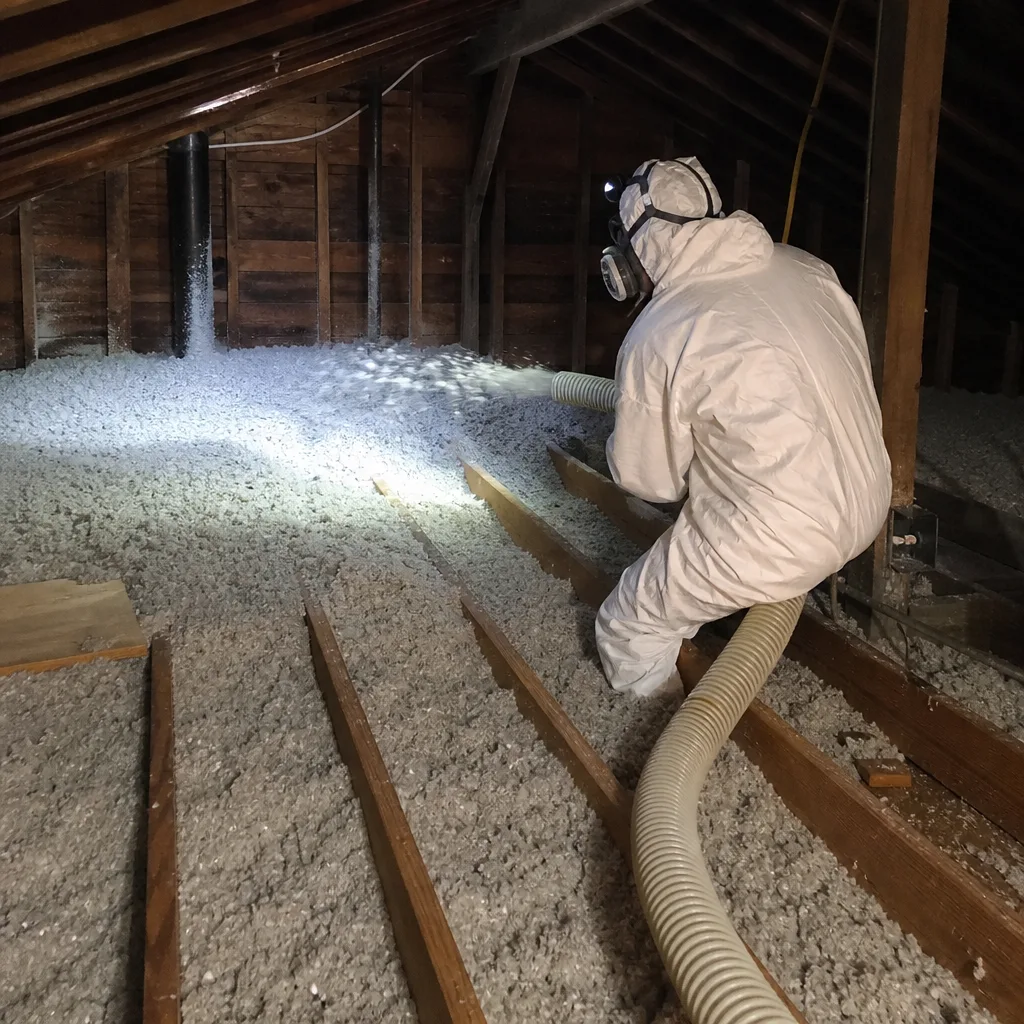
Cellulose is ground-up recycled paper treated with borate, which does two jobs: it insulates and it makes the material unappetizing to rodents and insects. We see it work particularly well in older Long Beach attics where access is tight and coverage needs to be uniform across odd joist spacing. We blow GreenFiber cellulose to a target R-value of R-38 in most attics, which is the current code recommendation for this climate zone, and we check coverage density with a depth gauge rather than eyeballing it. Nate handles the cellulose installs personally because the moisture content and fluff factor of the material determine whether it settles too much over time — a mistake you won’t notice until your energy bill creeps back up a year later. We also use the dense-pack method for walls when the situation calls for it.
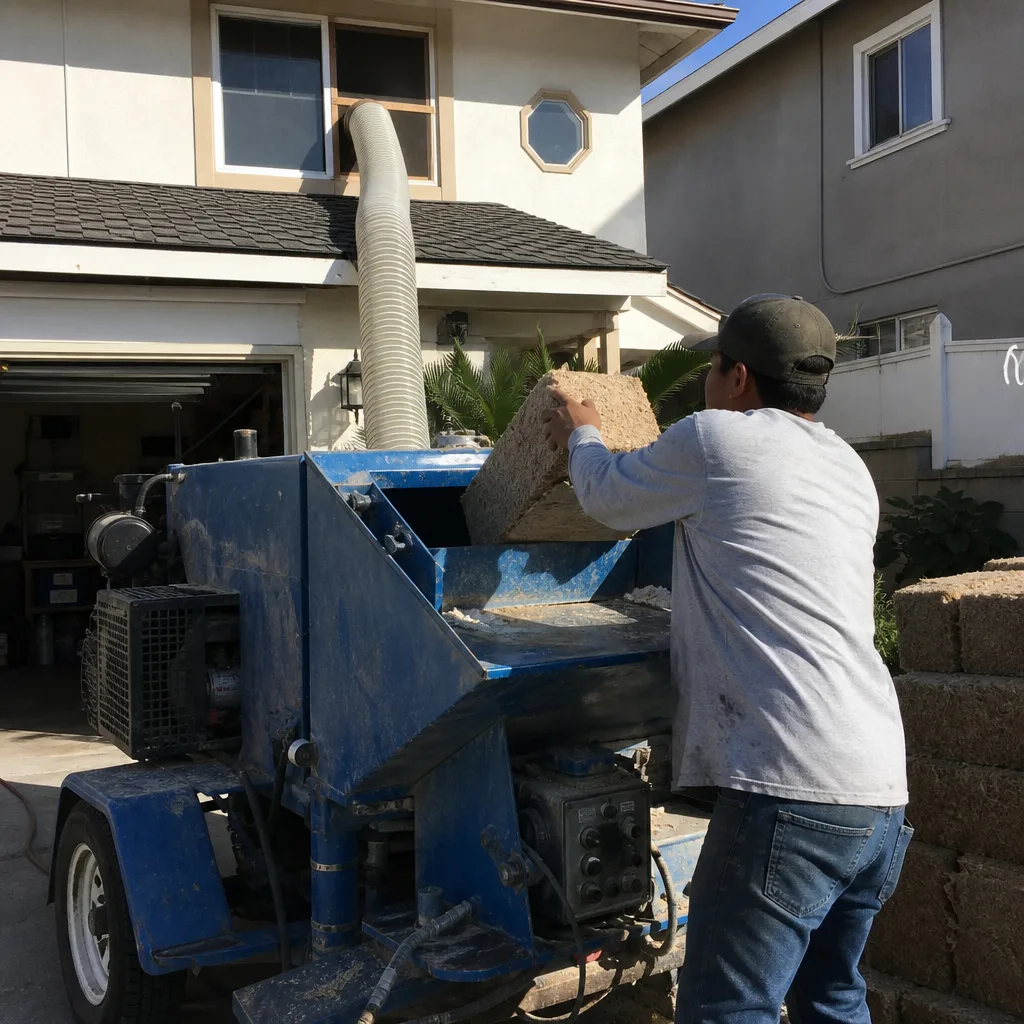
Blown-In Fiberglass
Blown-in fiberglass consists of tiny glass fibers that resist moisture and won’t settle as dramatically as cellulose when installed at the right density. In Long Beach’s coastal humidity, that matters more than people think — a damp attic in Belmont Shore or along the Peninsula can compress cellulose and reduce its R-value, while fiberglass sheds that moisture more readily. We also offer our Blown-In Insulation in Signal Hill for homes facing similar coastal conditions. We install Owens Corning AttiCat and Johns Manville Climate Pro blown fiberglass for homeowners who want a fiberglass product, or for spots where we’re topping up over existing fiberglass batts to keep the material consistent. One of the things that separates our installs from a handyman special is that we calibrate the blower machine for the specific material’s bag weight and fiber density; too much air pressure shreds the fibers and you end up with a fluffy blanket that looks thick but doesn’t hold heat the way it should. Our installs always include a quick post-install R-value verification.
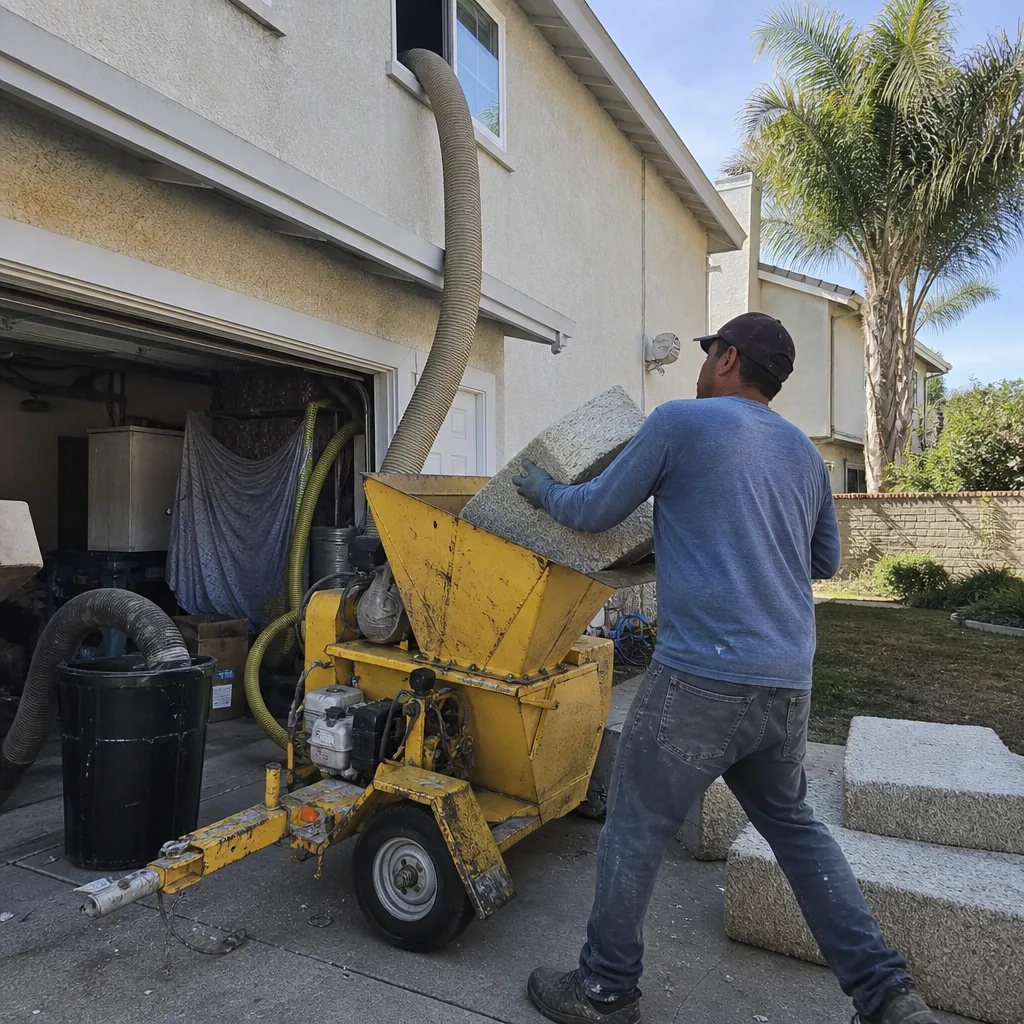
Dense-Pack Wall Insulation
Dense-pack is the process of blowing insulation into enclosed wall cavities under high pressure until the cavity is completely full. We do this for older Long Beach homes — much of the housing stock west of Cherry Avenue and north of 7th Street dates to the 1920s through 1950s and has walls that are empty. We also provide Carson Blown-In Insulation for similar vintage homes in that area. The most common symptoms are bedrooms that never hit the same temperature as the rest of the house and exterior walls that feel warm to the touch in the afternoon. We drill small access holes through the exterior sheathing or interior drywall, fill the cavity with either cellulose or fiberglass at verified density, and then patch the holes to a paintable finish. The difference between a real dense-pack job and a loose fill job is the pressure gauge — we fill until resistance hits roughly 3.5 pounds per cubic foot, which means the material won’t slump and leave a thermal void at the top of each stud bay.
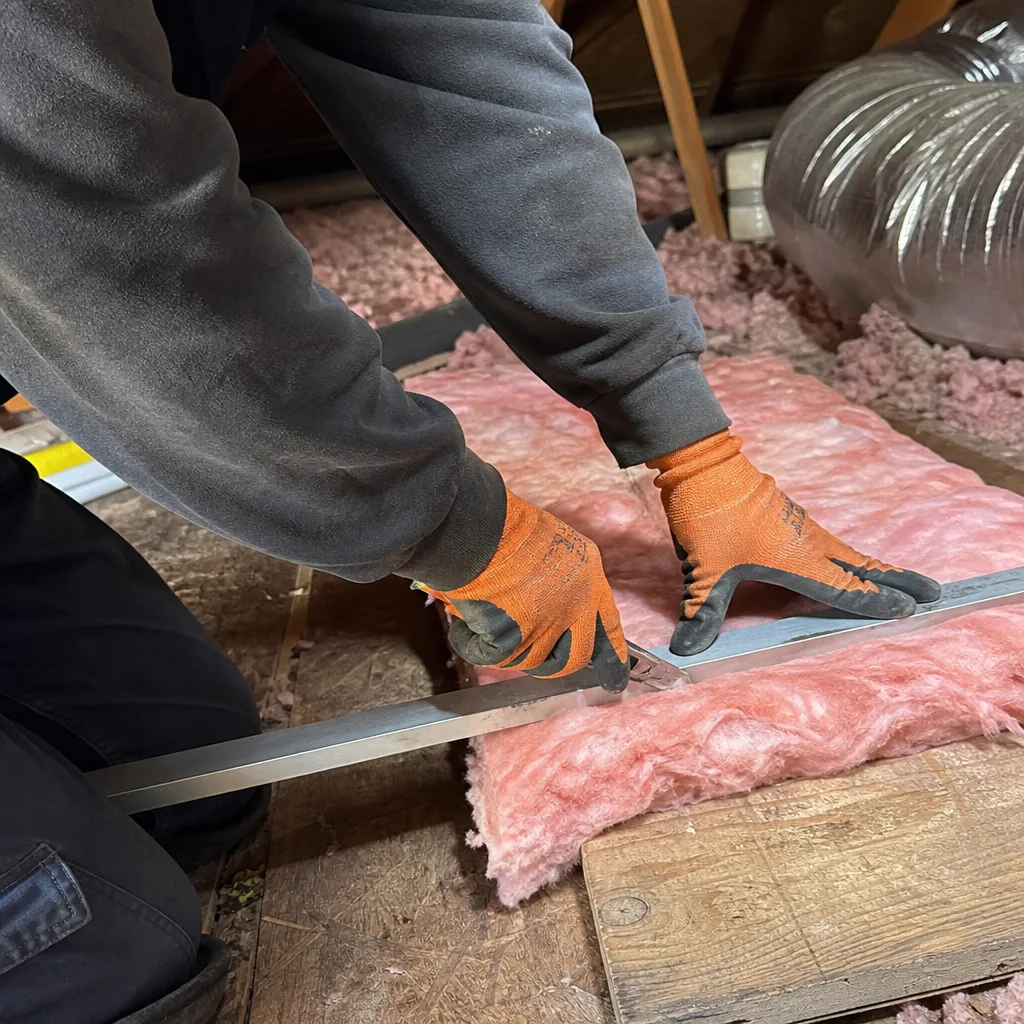
Blown-In Top-Up
A top-up is exactly what it sounds like: adding new blown-in material over insulation that’s already in the attic but has thinned out or settled. Most Long Beach homes we inspect have between 4 and 8 inches of old insulation when they should have 14 to 16 for an R-38 target. We assess the existing material first — if it’s been contaminated by rat droppings, mold, or decades of roof debris, we recommend removal before topping up, and we give you an honest read on whether a full blown-in insulation replacement in Long Beach is actually the better investment. In clean conditions, a top-up is the fastest path to good attic coverage, and we can usually complete one in a single afternoon. Before new insulation goes in, we make sure any air leaks from the ceiling plane are sealed, because insulation can’t do its job if conditioned air is blowing through it.
What happens when you call
- 1
A real person answersNo phone trees — you reach a local pro.
- 2
You get an upfront price rangeHonest numbers before anyone is dispatched.
- 3
A background-checked tech heads outLicensed & insured, dispatched right away.
- 4
You approve before work beginsNothing starts until you say go.
Brands We Service for Blown-In Insulation
We install and work around GreenFiber cellulose on a regular basis. GreenFiber’s SANCTUARY product is our go-to for attic blow-ins when the homeowner wants cellulose because it delivers consistent density and includes the borate treatment that keeps pests from nesting. We’ve blown hundreds of bags of it across Long Beach, and we know the material’s settling characteristics well enough to over-fluff by the exact percentage needed to hit the target R-value after normal settlement.
For fiberglass, we work primarily with Owens Corning AttiCat and Johns Manville Climate Pro. These are the two blown fiberglass products we recommend because they use a low-dust formulation and their blown R-values are independently documented. We also periodically spec materials from Icynene when the conversation turns to spray foam for difficult spots — but for true blown-in applications, our precision builds come down to GreenFiber, Owens Corning, and Johns Manville. Whether your current attic has a different brand or no brand at all, we can bring it up to standard with the material that makes sense for your home’s specific construction.
Signs You Need Blown-In Insulation Right Now
- Your energy bill spikes every summer and winter. Long Beach doesn’t get extreme heat for long, but those August stretches when the marine layer burns off by noon put real load on your AC. If your August bill is double your May bill, you’re likely cooling the attic too, which means there isn’t enough insulation between you and the roof deck. A top-up or full blow-in can flatten that spike, usually within the first full billing cycle.
- Bedrooms over the garage or at the far end of the house never hold temperature. These are the rooms with the least thermal mass under the roof and often the least attic insulation above them. In Long Beach ranch homes especially, the attic over the back bedroom is where the previous owner’s insulation job fell apart or was never done. Dense-pack wall insulation plus a blown attic top-up usually fixes the uneven temperature.
- You can see the tops of your ceiling joists in the attic. This is the simplest visual check there is. Walk into the attic during daylight and look at the floor. If you can see the 2×6 or 2×8 joists sticking up above the insulation line, you’re at maybe R-11 to R-19 at best, and you need at least twice that. We see this every week in homes throughout the Traffic Circle and El Dorado Park neighborhoods.
- You’ve had rodents or squirrels in the attic. Rodents don’t just stain insulation; they compress it down into dense, useless mats and leave waste that will smell forever if it stays up there. Blowing new insulation on top of a contaminated layer doesn’t fix the problem — it buries it. Before new insulation goes in, we recommend attic cleaning and rodent proofing, which we perform as part of the remediation before the blow-in.
- Your home was built before the 1980s and the attic has never been re-insulated. The majority of housing in central Long Beach went up between 1920 and 1975. Attic insulation from that era was often blown rock wool or thin fiberglass batt, and it’s degraded to near-zero effectiveness by now. If you’re in a house like this and no one’s touched the attic in forty years, you’re running essentially uninsulated, and a blow-in is the single highest-return upgrade you can make to your thermal envelope.
Our Blown-In Insulation Process — Step by Step
We don’t do mystery work. Every job follows the same sequence, and we’ll tell you at each step what we found and what it means. Here’s how a typical blown-in insulation job runs with Summit Insulation Long Beach.
- 1
Attic inspection and measurement. Nate gets into the attic himself, not a junior tech. He checks the existing insulation depth, looks for air leaks around ceiling penetrations, and spots any signs of water intrusion or pest activity. We measure the square footage and the joist layout, then calculate the exact number of bags needed to hit your target R-value.
- 2
Air sealing before insulation. Insulation is not a substitute for sealing. We identify and seal gaps around can lights, plumbing vents, wiring penetrations, and the attic hatch before any insulation goes in. In a typical Long Beach ranch home, this takes an hour or two and makes more difference than the last few inches of insulation ever will. If this step is skipped, you’re paying to insulate a sieve.
- 3
Prep and protection. We mask off the attic access with plastic sheeting and run the blower hose from the truck through the hatch or a gable vent. If walls are being dense-packed, we lay drop cloths inside and drill access points at each stud bay with a flat bit. Existing recessed light cans are checked for IC rating — if they’re not insulation-contact rated, we build or install proper damns around them before blowing.
- 4
Blowing to target depth and density. The blower machine is calibrated to the specific material — GreenFiber cellulose runs at a different gate setting than Owens Corning fiberglass. We blow to depth markers we set in the attic floor, then spot-check density with a depth gauge at multiple points. For dense-pack walls, we fill until the gauge on the hose reads the target psi and we can hear the cavity tighten.
- 5
Post-install verification and cleanup. This is where most contractors fall down, and where we don’t. Before we pack the truck, we take photos of the finished attic, verify coverage at the farthest corners, and confirm the hatch seal is tight. You get a summary of what was installed, the material brand and the installed R-value. If we found anything during the job that changes the picture — old knob-and-tube wiring, a cracked rafter, a roof leak you didn’t know about — we tell you directly, not buried in a text.
How Much Does Blown-In Insulation Cost in Long Beach?
A typical Blown-In Insulation pricing for an attic job in Long Beach runs $2,160 to $4,920 for a 1,200-square-foot attic brought up to R-38. Blown-in wall insulation via dense-pack runs higher per square foot — usually $2.80 to $4.10 — because of the drilling, filling, and patching involved. A straight attic top-up over existing clean insulation is the least expensive scenario, often falling between $900 and $1,600, because we’re only adding material and not starting from scratch. These are the real numbers we quote every day, and they include labor, material, cleanup, and the post-install R-value check.
What moves the price is the condition of your existing attic. If we have to remove old, contaminated insulation before blowing new, that adds removal and disposal costs — and you want it removed, because blow-over never fixes a rat problem or a moisture problem. If your attic is full of tight corners, excessive vents, or low pitch with limited access, labor time goes up. If we need to air-seal extensively around old can lights or a hundred drywall penetrations, that’s time in the attic. What we don’t do is inflate the price with mystery line items. When we give you a free estimate, it includes a written scope of work, the specific material we’ll use, the target R-value, and the total cost. Call Nate at (562) 784-9031 and he’ll walk the job with you personally.
Blown-In Insulation Near Long Beach — Our Service Area
We’re based in Long Beach and do most of our work within a 20-minute drive of home base. Typical response time for an estimate is same-day or next-day, and we schedule installs within 48 to 72 hours on most jobs. Our regular service area includes Lakewood to the north, Signal Hill, Bellflower, and the eastern corridor out through Commerce, plus Paramount, Cerritos, Carson, Whittier, Artesia, Compton, and Lynwood. If you’re not sure whether you’re in range, call us — if we can’t get to you, we’ll tell you straight.
Serving Long Beach, CA — Our Local Coverage Area
We’re based in the Long Beach area and know this community well. Use the map below to see our service coverage — if you’re nearby, we can almost certainly help.
Frequently Asked Questions — Blown-In Insulation in Long Beach
Blown-in insulation is loose insulation material — either cellulose or fiberglass — that gets pneumatically blown into an attic or wall cavity through a hose rather than laid down as batts. It’s the fastest way to achieve uniform coverage and is the preferred method for topping up thin insulation or filling enclosed wall cavities in existing homes. In Long Beach, where most homes aren’t built new, it’s the most common insulation installation method we perform by a wide margin.
An average attic blow-in in Long Beach takes us four to six hours on-site, including setup, air sealing, blowing, and cleanup. A dense-pack wall job on a single-story home typically takes a full day, because each stud bay gets individually drilled, filled, and patched. If removal of old insulation is required, add half a day. You don’t need to be home the entire time, but we do need access to the attic and a clear path from the truck to the hatch.
Most Long Beach attic blow-ins land between $2,160 and $4,920, while wall dense-pack work runs $2.80 to $4.10 per square foot. Your specific cost depends on attic square footage, target R-value, the material you choose, and the condition of your existing insulation. We give free estimates with a firm written quote before any work begins — call (562) 784-9031 and Nate will walk your attic himself.
Yes, and you’re in the majority. Most Long Beach attics we enter have some old Owens Corning batt or a previous GreenFiber blow-in that’s settled below code. We can install a GreenFiber or Owens Corning top-up over compatible existing material, or remove the old insulation entirely if it’s contaminated. We match the material to what’s already up there to avoid density and moisture compatibility problems.
We do our best to get to estimate appointments same-day when you call before noon, and we schedule installations within 48 to 72 hours on most Long Beach jobs. During spring and early summer, before the heat really settles in, our calendar fills faster — call (562) 784-9031 and we’ll give you the soonest open slot straight. We don’t do emergency retrofits in the middle of the night, but we’ll always get to you as fast as the calendar allows.
We back every install with a workmanship warranty covering our labor, alongside the manufacturer’s material warranty on the product we install. If the blown-in material settles below the R-value we specified in the scope of work within the warranty window, we’ll re-fluff and top it up at no cost. We’re a small, local company — if something’s not right, Nate comes back himself, not a sub.
Before we arrive, clear a path from the exterior door to the attic hatch and remove any stored items or valuables from the attic floor. If we’re doing wall insulation, move furniture a few feet away from the walls we’ll be drilling into. We bring all the material, equipment, and protection — you don’t need to provide anything. We’ll handle the cleanup inside and out before we leave.
Schedule Your Blown-In Insulation Service in Long Beach Today
If your attic’s thin, your walls are hollow, or your energy bill is rising without explanation, don’t wait another season. Blown-in insulation is one of the fastest, highest-return improvements you can make to a Long Beach home, and we’ll quote it honestly with no pressure and no mystery. Call Nate at (562) 784-9031 and he’ll inspect your attic, give you a clear written estimate, and tell you the truth about what needs to happen. Free estimate, no obligation, and the owner does the install himself.
Written by Nate Calloway, Owner and Lead Installer at Summit Insulation Long Beach, serving Long Beach and surrounding communities.