
Spray Foam Insulation in Rolling Hills Estates, CA
Spray foam insulation in Rolling Hills Estates addresses the two persistent problems we see in homes across the Palos Verdes Peninsula: chronic marine-layer moisture and unconditioned air moving through aging ranch-style framing. Homes here were largely built between the late 1950s and early 1970s, before California’s Title 24 energy code existed, so wall cavities and rim joists are almost always empty. Closed-cell spray foam solves both problems at once by expanding into those cavities to form an air and vapor seal that batt insulation simply cannot replicate. Call (562) 784-9031 and we’ll tell you whether foam is the right fit for your home’s construction.
What we’re really doing on a Rolling Hills Estates spray foam job is building an air barrier. The foam does the insulating, but its bigger contribution in this microclimate is stopping the condensation cycle that forms when warm interior air meets cold, fog-saturated framing. For a full technical breakdown of what foam can and can’t do in your specific roof assembly, read our Spray Foam Insulation page before making a decision.
Why Rolling Hills Estates Homes Are Different
Homes on the Hill behave differently than houses five miles east in Torrance or Gardena. The marine layer sits over Rolling Hills Estates for months at a time, and that persistent damp changes what insulation is supposed to do. In a hot, dry climate, insulation mostly slows heat gain. Here, it has to manage moisture movement too.
The housing stock makes this more urgent. The city’s residential fabric is dominated by single-story ranch homes on graded hillside lots, many with vented crawl spaces or raised post-and-pier foundations. Those crawl spaces pull cold, damp marine air directly through uninsulated floor decks, a failure mode we diagnose constantly in this specific area. The temperature swing between clear inland-wind days and cold marine-layer nights creates repeated condensation cycles inside poorly insulated envelopes, which slowly degrades whatever batting was originally installed. Most of these homes have original fiberglass batts in the attic, if anything at all, and bare stud walls throughout. The primary insulation problem here isn’t just thermal performance. It’s preventing condensation-driven mold inside aging cavities exposed to chronic coastal humidity.
Our Main Rolling Hills Estates Services
Two services get the most calls from Rolling Hills Estates homeowners, and they’re related. The first is attic insulation in the original ranch homes, where the ceiling is usually the thinnest part of the thermal envelope. The second is crawl space work, because the raised foundation design here creates a moisture problem most flatland homes never experience.
Attic Insulation in Rolling Hills Estates
Most ranch homes in Rolling Hills Estates have a thin layer of original fiberglass in the attic, often compressed to under R-19 by decades of roof traffic and settling. That’s a fraction of what a coastal home should carry. The job here starts with an attic inspection, because we regularly find condensation damage from the marine layer that has to be addressed before new material goes in. See the full scope on our Attic Insulation in Rolling Hills Estates page.
Crawl Space Encapsulation & Vapor Barrier in Rolling Hills Estates
The vented crawl spaces under these older ranch homes pull cold, damp marine air directly under the floor deck year-round. That cools the living space from below and keeps the framing moist, which is why native hardwood floors in Rolling Hills Estates homes often cup or warp. We install a vapor barrier on the crawl space floor and seal the foundation vents, then condition the space with a dehumidifier sized for the square footage. Read the full breakdown on our Crawl Space Encapsulation & Vapor Barrier in Rolling Hills Estates page.
What happens when you call
- 1
A real person answersNo phone trees — you reach a local pro.
- 2
You get an upfront price rangeHonest numbers before anyone is dispatched.
- 3
A background-checked tech heads outLicensed & insured, dispatched right away.
- 4
You approve before work beginsNothing starts until you say go.
Spray Foam Insulation in Rolling Hills Estates
Spray foam in Rolling Hills Estates is the strongest answer for homes that have chronic cold floors, condensation on attic sheathing, or energy bills that spike whenever the marine layer moves in. The foam expands into every irregular cavity, sealing the exact gaps where damp coastal air sneaks through. For mid-century ranch homes with no wall insulation, closed-cell foam can be injected into stud bays without tearing out drywall. For vented attics, open-cell foam on the roof deck converts the space into a conditioned, semi-sealed attic that stops the summer heat from ever entering the living area.
Open-Cell Spray Foam
Signs you need it
Your attic is vented but stays damp and musty. Ceiling drywall shows faint water staining in corners. You hear roof wind noise or feel drafts near recessed lights.
What it costs in Rolling Hills Estates
Open-cell foam in a Rolling Hills Estates attic typically runs $3.50 to $5.50 per board foot installed, depending on depth and access.
How we do it
We prep the attic by sealing any existing bypasses, then spray the foam directly against the roof deck to a specified depth. We leave the soffit vents clear and check that the attic reaches the right temperature within a day against the home’s duct layout.
Closed-Cell Spray Foam
Signs you need it
Your crawl space smells like earth or diesel and floorboards feel cold even in summer. You have exposed rim joists at the foundation edge. The walls are bare stud and you want insulation plus an air and vapor barrier in one step.
What it costs in Rolling Hills Estates
Closed-cell foam for crawl spaces and rim joists in Rolling Hills Estates generally runs $0.90 to $2.50 per board foot, with total job pricing driven by cavity depth and square footage.
How we do it
We foam the rim joist bays first, then move to the underside of the floor deck if the homeowner wants the full floor conditioned. The material cures hard in under a minute and we trim each bay flush to the joists before it sets.
Rim Joist Spray Foam
Signs you need it
Floor edges feel drafty. You can see daylight through gaps where the house meets the foundation, or rodents have chewed their way in at the sill plate.
What it costs in Rolling Hills Estates
Rim joist sealing with spray foam in Rolling Hills Estates runs $0.90 to $1.25 per linear foot installed on average, depending on bay size and access height.
How we do it
We cut back any fiberglass that’s compressed against the rim, then spray closed-cell foam in each bay from the interior. Once it cures we inspect from outside for any air paths that remain. The result is a complete air, vapor, and thermal break at the floor perimeter.
Spray Foam Roof Deck
Signs you need it
Rooms under the attic run ten degrees hotter than the rest of the house on sunny days. Your ridge vent isn’t moving enough air, and the attic sheathing is damp to the touch. The home is a ranch with no shade on the south-facing roof slope.
What it costs in Rolling Hills Estates
Roof deck spray foam in Rolling Hills Estates runs $5.50 to $7.50 per board foot installed for open-cell and $7.50 to $9.50 for closed-cell, depending on rafter depth and roof complexity.
How we do it
We seal all existing vents and penetrations, then spray the foam directly to the underside of the roof deck in a single continuous layer, pulling the attic inside the home’s conditioned envelope. We then verify that the new sealed attic holds a stable temperature during the next marine-layer cycle.
What Spray Foam Insulation Costs in Rolling Hills Estates
| Item | Typical range in Rolling Hills Estates |
|---|---|
| Open-cell spray foam (attic) | $3.50 – $5.50 / board foot |
| Closed-cell spray foam (crawl space & rim joists) | $0.90 – $2.50 / board foot |
| Rim joist spray foam | $0.90 – $1.25 / linear foot |
| Roof deck spray foam (open-cell) | $5.50 – $7.50 / board foot |
| Roof deck spray foam (closed-cell) | $7.50 – $9.50 / board foot |
Does spray foam work in a marine layer climate?
Yes, and it’s uniquely suited to Rolling Hills Estates. Closed-cell foam in particular acts as both an air and vapor barrier, which stops the condensation cycle between warm interior air and cold, fog-saturated framing. That’s the failure mode batt insulation can’t prevent here.
How long does a typical spray foam job take in Rolling Hills Estates?
Most rim joist or crawl space jobs finish in a single day. A full attic roof deck with open-cell foam takes one to two days, and we schedule around the weather to avoid spraying during heavy fog when the substrate holds more moisture. Call (562) 784-9031 for your home’s timeline.
Blown-In Insulation in Rolling Hills Estates
Blown-in insulation is the workhorse answer for the original ranch attics in Rolling Hills Estates. Most homes here have either nothing, or a thin layer of compressed fiberglass that’s been walked on, rained on through ridge leaks, and stripped of its loft. Blown-in cellulose or fiberglass can be applied directly over what’s there without disturbing the ceiling below, and it fills the irregular joist bays that are a signature of the era’s framing. On the Hill, we lean toward GreenFiber cellulose in these attics because its density settles into every odd cavity and does a better job slowing the damp marine air that moves through the soffit vents.
For a full look at material options and coverage rates, see our Blown-In Insulation page.
Blown-In Cellulose
Signs you need it
Your attic insulation is settled below the top of the joists. Rooms feel drafty when the marine layer rolls in. You see rodent droppings in the existing batting and want new material over a cleaned deck, not mixed into contaminated fiber.
What it costs in Rolling Hills Estates
Blown-in cellulose in a Rolling Hills Estates attic typically runs $1.50 to $3.50 per square foot installed, depending on target R-value and existing material condition.
How we do it
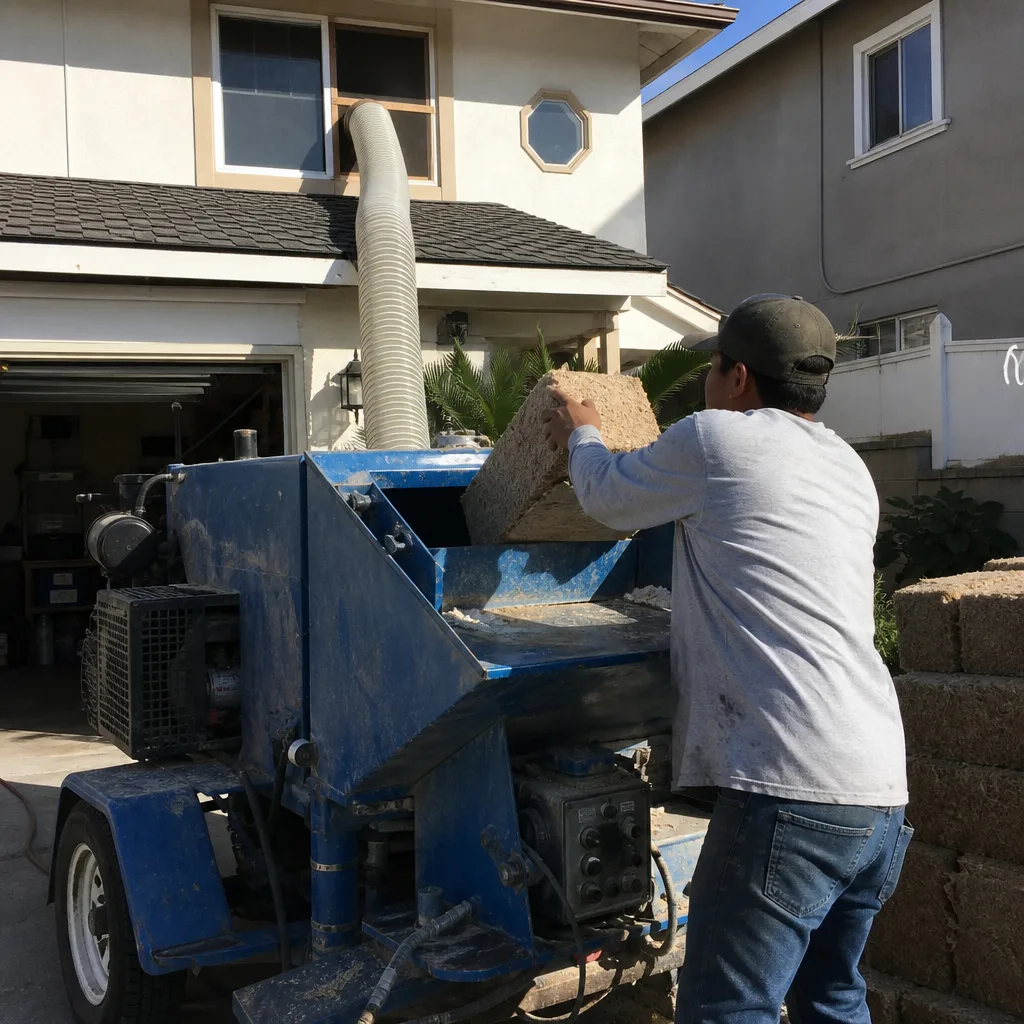
We prep the attic by flagging all recessed lights and building dams around them, then run a hose from the truck and blow the cellulose to a consistent depth across every bay. We check final depth with a gauge and tune the density so it won’t settle below the target R-value.
Blown-In Fiberglass
Signs you need it
You want a non-organic material in a damp attic where cellulose might hold moisture. The existing batting is mold-free but too thin, and you want a clean top-up over a sealed attic floor.
What it costs in Rolling Hills Estates
Blown-in fiberglass in Rolling Hills Estates runs $1.25 to $3.00 per square foot installed, depending on depth and whether we’re topping up or starting from bare deck.
How we do it
We blow Owens Corning or Johns Manville loose-fill fiberglass to the specified depth, maintaining a consistent layer even around roof trusses and cross-bracing. Because fiberglass doesn’t settle like cellulose, we install it to a slightly higher initial depth to hold the target R-value over time.
Dense-Pack Wall Insulation
Signs you need it
Your ranch home’s stud bays are empty, or they hold a thin strip of compressed batting that leaves the outer third of the wall bare. Rooms along the hillside-facing elevation are always cold, and the drywall is cool to the touch in the morning.
What it costs in Rolling Hills Estates
Dense-pack wall insulation in Rolling Hills Estates typically ranges $2.50 to $5.50 per square foot of wall, depending on access from the exterior or interior and cavity obstructions.
How we do it
We drill small access holes into each stud bay, either through the stucco exterior or the drywall interior, and pack the cavity full with cellulose under pressure. Once we’ve verified every bay is filled, we seal and patch the access points so they’re ready for paint.
Blown-In Top-Up
Signs you need it
Your existing attic insulation is clean and dry but below code. You want better thermal performance without removing what’s already there. The current depth measures under six inches.
What it costs in Rolling Hills Estates
A blown-in top-up over existing attic insulation in Rolling Hills Estates runs $1.00 to $2.50 per square foot, depending on the current depth and target R-value.
How we do it
We first air seal the attic floor around all penetrations and top plates, then blow the new material over the old layer to reach the target depth. The air sealing step is what most contractors skip, and it’s the difference between an attic that holds heat and one that just looks thicker.
What Blown-In Insulation Costs in Rolling Hills Estates
| Item | Typical range in Rolling Hills Estates |
|---|---|
| Blown-in cellulose (attic) | $1.50 – $3.50 / sq ft |
| Blown-in fiberglass (attic) | $1.25 – $3.00 / sq ft |
| Dense-pack wall insulation | $2.50 – $5.50 / sq ft of wall |
| Blown-in top-up (over existing) | $1.00 – $2.50 / sq ft |
Is blown-in insulation better than batts for old ranch homes?
Usually, yes. The irregular joist bays and odd framing in Rolling Hills Estates ranch homes are hard to fit with batts without leaving air gaps. Blown-in material flows into every corner and eliminates those gaps, which is what actually drives comfort on the Hill.
Can you blow insulation into my walls without tearing out drywall?
Yes. Dense-packing through small drilled holes is the standard method for the hollow stud walls in Rolling Hills Estates ranch homes. We patch and leave the holes ready for a quick skim coat. Call (562) 784-9031 and we’ll tell you if your wall construction allows it.
Radiant Barrier Installation in Rolling Hills Estates
Radiant barrier does something no batt or blown-in material can: it reflects heat away from the living space before the attic ever absorbs it. That’s a particular advantage on the Palos Verdes Peninsula, where the sun beats on south-facing ranch roof decks even during months when the outdoor air stays cool. A radiant barrier mounted to the underside of the roof rafters cuts the radiant heat gain that drives attic temperatures up 20 to 30 degrees, which means your existing insulation works less hard. Combined with air sealing, it’s one of the best investments for these older Rolling Hills Estates homes that suffer more from heat than from extreme cold.
For a deep-dive on how the physics works and when it doesn’t make sense, see our Radiant Barrier Installation page.
Attic Radiant Barrier
Signs you need it
Your attic is a furnace by early afternoon, even on mild coastal days. The upstairs or south-facing rooms run noticeably warmer than the rest of the house. Your air conditioner cycles on and off through the hottest part of the day when the thermostat barely moves.
What it costs in Rolling Hills Estates
Attic radiant barrier in Rolling Hills Estates runs $1.00 to $2.50 per square foot installed, depending on rafter spacing and attic obstructions.
How we do it
We staple a perforated, double-sided foil barrier to the underside of the roof rafters, maintaining a continuous air gap on the reflective side. We keep the soffit and ridge vents clear so the attic still breathes, and we wrap around any roof penetrations with full edge laps.
Radiant Barrier Foil
Signs you need it
You want the reflective benefit without replacing your insulation. The existing attic material is clean and adequate but the attic still overheats. Your roof has a clear south or west exposure with no tree cover.
What it costs in Rolling Hills Estates
Radiant barrier foil in a Rolling Hills Estates attic typically runs $1.00 to $2.00 per square foot installed, depending on coverage pattern and rafter access.
How we do it
We roll the foil across the rafters and staple it into place, laying it flat with the reflective side facing down toward the attic floor. The foil needs an air gap below it to work, so we maintain that spacing as we install, trimming around vents and electrical runs.
Radiant Barrier Roof Deck
Signs you need it
Your roof deck is exposed in a vaulted or cathedral ceiling with no attic space. The ceiling surface is hot to the touch. You want to stop heat transfer at the roof itself because there’s no attic ventilation to carry it away.
What it costs in Rolling Hills Estates
Radiant barrier on a roof deck in Rolling Hills Estates runs $1.50 to $3.00 per square foot installed when married to the existing roof assembly, depending on access.
How we do it
We attach the barrier to the underside of the roof deck before the finished ceiling is installed, leaving an air gap on the reflective side. In a retrofit, we’re often working in tandem with a roof replacement or a full ceiling demo, so we schedule around the other trades.
Radiant Barrier & Ventilation
Signs you need it
Your attic has a radiant barrier but still feels moist, a sign the vents are clogged or undersized. Or your attic has good ventilation but still overheats, meaning the barrier alone won’t solve the problem without better air movement.
What it costs in Rolling Hills Estates
Radiant barrier paired with ventilation upgrades in Rolling Hills Estates runs $1.25 to $3.00 per square foot installed when bought as a combined scope, depending on vent type and attic size.
How we do it
We assess the current venting first, using an airflow calculation to see if the ridge and soffit vents are balanced. Then we install the barrier and the necessary vent upgrades together, so the attic doesn’t just reflect heat but moves the residual moisture out before it condenses.
What Radiant Barrier Installation Costs in Rolling Hills Estates
| Item | Typical range in Rolling Hills Estates |
|---|---|
| Attic radiant barrier | $1.00 – $2.50 / sq ft |
| Radiant barrier foil | $1.00 – $2.00 / sq ft |
| Radiant barrier roof deck | $1.50 – $3.00 / sq ft |
| Radiant barrier & ventilation | $1.25 – $3.00 / sq ft |
Does radiant barrier help in a cool, foggy climate?
It helps on clear days, which the Hill gets plenty of despite the marine layer. On sunny afternoons when the roof deck bakes, the barrier stops most of that radiant heat from ever reaching the insulation surface below, keeping the living space cooler without changing your thermostat settings.
Can radiant barrier be added to my existing attic?
Yes. We staple it directly to the underside of the existing rafters without touching your current insulation. The only exception is a roof leak or structural problem, which we flag before we install so you don’t spend money over a failing substrate. Call (562) 784-9031 to schedule a look.
Insulation Removal & Replacement in Rolling Hills Estates
Insulation removal in Rolling Hills Estates is not a cosmetic job. The marine layer that rolls over the Peninsula keeps attic cavities damp, and when old fiberglass gets wet or contaminated by rodents, it stops working and starts breeding mold. Many of these ranch homes have original batts from the 1960s or 1970s that have been soaked by decades of condensation cycles, then chewed through by rats and squirrels that live in the hillside brush. Before new insulation goes in, that old material has to come out, the deck gets cleaned and sanitized, and only then do we install fresh material. Skipping that step is the single most common mistake we see from lowest-bid contractors.
Our full process, including the sanitizing step, is covered on the Insulation Removal & Replacement page.
Attic Insulation Removal
Signs you need it
Your attic insulation is compressed, damp, or has visible rodent droppings. The material has been in place since the home was built and has never been replaced. You’re getting musty air pulling down through the ceiling.
What it costs in Rolling Hills Estates
Attic insulation removal in Rolling Hills Estates typically runs $1.00 to $2.50 per square foot, depending on material type, depth, and degree of contamination.
How we do it
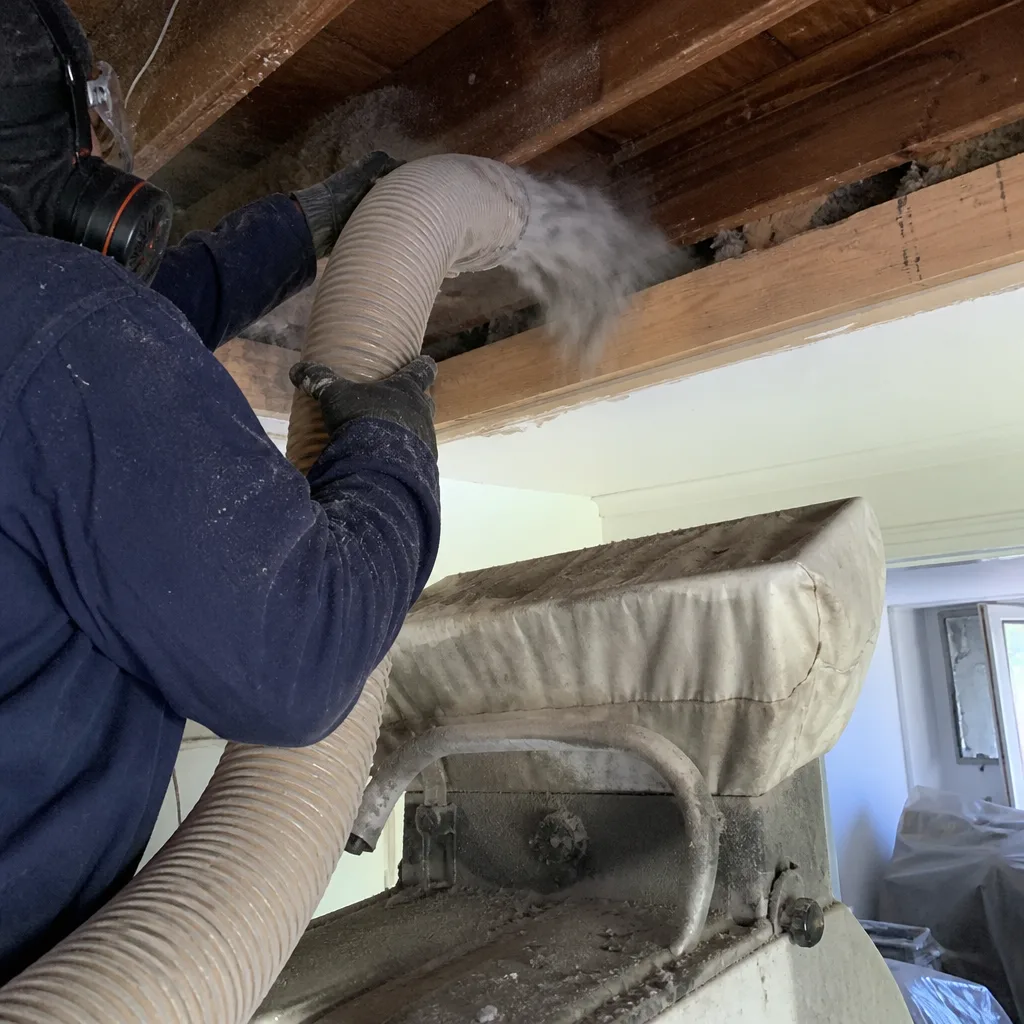
We run a high-powered vacuum hose from the truck to the attic and pull every bit of the old material out through a sealed system that never vents dust into your living space. We bag everything at the truck and leave the attic floor bare and swept before any new work starts.
Contaminated Insulation Removal
Signs you need it
You smell a persistent musty odor in the hallway. You’ve had rodents in the attic and the material is saturated with droppings and urine. A previous leak left brown staining across large sections of the batting.
What it costs in Rolling Hills Estates
Contaminated insulation removal in Rolling Hills Estates runs $1.50 to $3.00 per square foot, depending on the severity of contamination and whether sanitizing is needed.
How we do it
We treat contaminated material as a biohazard and remove it through the same sealed vacuum system, wearing full protective gear. After the deck is bare we apply a hospital-grade sanitizer and let it dry completely before new insulation is blown in. We never layer new material over contaminated fiber.
Vermiculite & Old Insulation Removal
Signs you need it
You see a pebble-like, gray-brown granular material in your attic that doesn’t look like fiberglass or cellulose. The home was built before the mid-1980s. You’re planning a remodel and want the attic fully cleared before electrical or HVAC work.
What it costs in Rolling Hills Estates
Vermiculite removal in Rolling Hills Estates runs $2.00 to $4.00 per square foot due to special handling requirements, depending on volume and access.
How we do it
We use the sealed vacuum system and follow strict containment protocols for any vermiculite that may contain asbestos. The material is double-bagged and disposed of through a certified facility, and we test the air afterward to confirm the attic is clear before we proceed.
Insulation Replacement
Signs you need it
The old insulation is gone or cleaned out and you want new material installed in the same visit. You’re upgrading from R-19 to R-38 or higher. The home is being prepped for sale and the buyer’s inspector flagged the attic.
What it costs in Rolling Hills Estates
Insulation replacement in Rolling Hills Estates runs $1.50 to $3.50 per square foot for the new material after removal, depending on the type we install.
How we do it
After the old material is out and the deck is dry, we air seal every penetration and top plate, then blow in fresh material to the target R-value. The air sealing step is included, because replacing insulation without sealing the air paths underneath is half a job.
What Insulation Removal & Replacement Costs in Rolling Hills Estates
| Item | Typical range in Rolling Hills Estates |
|---|---|
| Attic insulation removal | $1.00 – $2.50 / sq ft |
| Contaminated insulation removal | $1.50 – $3.00 / sq ft |
| Vermiculite & old insulation removal | $2.00 – $4.00 / sq ft |
| Insulation replacement (new material after removal) | $1.50 – $3.50 / sq ft |
Can you remove my old insulation and install new in the same day?
Yes, for most ranch homes in Rolling Hills Estates we can remove and replace attic insulation in a single day. If the deck needs to dry after sanitizing, we’ll schedule the new material for the following morning. Call (562) 784-9031 and we’ll tell you which path your attic needs.
Is it cheaper to just blow insulation over the old contaminated material?
It looks cheaper on paper, and that’s exactly why so many companies do it. But layering new material over rodent-contaminated or moldy insulation just buries the problem under a warm blanket. The contamination keeps off-gassing into your living space. In Rolling Hills Estates, with the moisture load these attics carry, we remove first.
Attic Air Sealing in Rolling Hills Estates
Attic air sealing is the least visible work we do in Rolling Hills Estates, and it’s often the most valuable. These ranch homes were framed fast and sealed with nothing, which means the attic is connected to the living space through hundreds of small gaps around top plates, recessed lights, plumbing vents, and the attic hatch. Every one of those gaps is a path for warm, humid interior air to leak up into a cold attic, where it condenses against the sheathing and drips back down. Air sealing stops that cycle at the source. Before we install any new attic insulation in Rolling Hills Estates, we seal the attic floor. No exceptions.
Learn what we seal and how we test it on our Attic Air Sealing page.
Attic Floor Air Sealing
Signs you need it
You feel a draft near the ceiling in winter. The insulation looks dirty around certain edges, a sign air is moving through it. Your energy bill spikes when the marine layer rolls in and the furnace runs more.
What it costs in Rolling Hills Estates
Attic floor air sealing in Rolling Hills Estates runs $0.75 to $2.00 per square foot, depending on the number of penetrations and access.
How we do it
We pull back the existing insulation around every penetration, foam and caulk each gap, then lay the insulation back down. We work in sections across the entire attic floor so no pathway is missed, including the areas under the eaves that are hardest to reach.
Top Plate & Penetration Sealing
Signs you need it
You can see dirty insulation around the electrical and plumbing penetrations. The walls feel drafty at the ceiling line. Your attic has a constant musty smell that won’t go away.
What it costs in Rolling Hills Estates
Top plate and penetration sealing in Rolling Hills Estates runs $1.00 to $2.50 per linear foot, depending on accessibility under the roof slope.
How we do it
We seal the gap where the drywall meets the top plates of every wall, using foam for large gaps and caulk for hairline cracks. Around plumbing vents and electrical wires, we use a fire-rated sealant that won’t degrade in the unconditioned attic heat.
Can Light & Duct Boot Sealing
Signs you need it
You have recessed can lights in the ceiling and the attic is directly above. The air handler and duct boots sit in the unconditioned attic and the joints look dark. Rooms near the air handler are noticeably dustier than the rest of the house.
What it costs in Rolling Hills Estates
Can light and duct boot sealing in Rolling Hills Estates runs $25 to $75 per fixture or boot, depending on the type and condition of the existing housing.
How we do it
We build an airtight box or cover over each recessed light from the attic side, using fire-rated materials and leaving the required clearance for heat. At every duct boot, we seal the connection between the drywall and the boot with mastic and foam so conditioned air stops leaking into the attic.
Attic Hatch Sealing
Signs you need it
Your hallway or closet near the attic hatch is always cold or hot. You can feel air moving around the hatch when the furnace kicks on. The hatch is an uninsulated piece of drywall or plywood with no weatherstripping.
What it costs in Rolling Hills Estates
Attic hatch sealing in Rolling Hills Estates runs $100 to $300 per hatch installed, depending on hatch size and whether we build an insulated cover.
How we do it
We install weatherstripping around the hatch perimeter and build an insulated cover that sits over the opening from the attic side. The cover is taped and sealed at the edges so the attic air can’t pull inside, and we weight it lightly so it stays put.
What Attic Air Sealing Costs in Rolling Hills Estates
| Item | Typical range in Rolling Hills Estates |
|---|---|
| Attic floor air sealing | $0.75 – $2.00 / sq ft |
| Top plate & penetration sealing | $1.00 – $2.50 / linear ft |
| Can light & duct boot sealing | $25 – $75 / fixture |
| Attic hatch sealing | $100 – $300 / hatch |
Why does air sealing matter more in Rolling Hills Estates than inland?
Because the marine layer means the attic is cold and damp more often than the living space. Warm, humid air leaking into that cold attic condenses immediately against the sheathing. In a dry inland climate the same leak just costs energy. Here it costs you mold and rot if left alone.
Should I air seal before or after adding new attic insulation?
Before. The sealing has to happen at the attic floor, under the insulation. If you add new insulation first, every penetration is buried and the sealing job becomes a full removal. We always seal first, then blow the new material on top. Call (562) 784-9031 to schedule the right sequence.
Wall Insulation in Rolling Hills Estates
Wall insulation is the single biggest energy retrofit most Rolling Hills Estates homes never get. The ranch-era construction that dominates the city used bare stud walls with nothing in the cavities, and what was installed later is usually a thin fiberglass batt that’s sagged and left air channels along the edges. We inject foam or dense-pack cellulose directly into those stud bays through small holes, turning an empty wall into a filled, air-sealed cavity without tearing out drywall. On the Hill, wall insulation matters twice: it keeps the damp marine air from moving through the walls, and it stops the cold-air convection loop that makes hillside-facing rooms permanently chilly.
For the technical options and what’s right for your wall assembly, read our Wall Insulation page.
Injection Foam Wall Insulation
Signs you need it
Your stud bays are empty or barely filled. You can hear outside noise clearly through exterior walls. The walls radiate cold in winter even when the thermostat is set high.
What it costs in Rolling Hills Estates
Injection foam wall insulation in Rolling Hills Estates runs $2.50 to $5.50 per square foot of wall, depending on access and cavity condition.
How we do it
We drill injection holes at each stud bay, either through the exterior stucco or the interior drywall, and pump a slow-rise foam that fills the cavity from the bottom up. The foam air-seals as it expands, which gives you insulation and a vapor barrier in one step.
Drill & Fill Wall Insulation
Signs you need it
Your exterior walls have no insulation and you want the most cost-effective fill. You’re already patching or repainting the exterior, so hole patching is easy to hide. The wall cavity is clean and free of obstructions.
What it costs in Rolling Hills Estates
Drill and fill wall insulation in Rolling Hills Estates runs $2.50 to $5.50 per square foot of wall, depending on cavity depth and siding type.
How we do it
We drill one hole per stud bay and blow dense-pack cellulose or fiberglass into each cavity under pressure, working from the bottom of the wall up. Once each bay is confirmed full, we plug the holes with a matching patch that’s ready for the homeowner’s paint or texture.
Exterior Wall Insulation
Signs you need it
The siding or stucco is coming off for a remodel or reroof, and the walls are exposed. You want continuous insulation on the outside face of the sheathing. The home has curved or irregular walls that are hard to fill from the interior.
What it costs in Rolling Hills Estates
Exterior wall insulation in Rolling Hills Estates runs $3.00 to $7.00 per square foot of wall, depending on the material and the overhang details.
How we do it
We install rigid foam or Rockwool board over the exterior sheathing while the wall is open, taping all seams and sealing the edges to create a continuous thermal break. Then the siding or stucco contractor covers it, and we inspect before the final layer goes on.
Interior Wall Soundproofing
Signs you need it
You hear traffic from Crenshaw or Hawthorne Boulevard inside the living room. A bedroom shares a wall with a busy hallway or laundry. You want to reduce noise transfer between rooms without major construction.
What it costs in Rolling Hills Estates
Interior wall soundproofing in Rolling Hills Estates runs $3.00 to $6.00 per square foot of wall, depending on whether we use dense-pack cellulose or Rockwool batts.
How we do it
We fill the interior wall cavities with mineral wool or dense-packed cellulose, which adds mass and stops sound from moving through the studs. For the highest STC rating, we can add a second layer of drywall with a damping compound, all after the insulation is in.
What Wall Insulation Costs in Rolling Hills Estates
| Item | Typical range in Rolling Hills Estates |
|---|---|
| Injection foam wall insulation | $2.50 – $5.50 / sq ft of wall |
| Drill & fill wall insulation | $2.50 – $5.50 / sq ft of wall |
| Exterior wall insulation | $3.00 – $7.00 / sq ft of wall |
| Interior wall soundproofing | $3.00 – $6.00 / sq ft of wall |
Can you insulate my walls without removing the drywall?
Yes. We drill small access holes through the drywall or the exterior and fill each stud bay with foam or dense-packed cellulose. The holes are patched and ready for paint. For most ranch homes in Rolling Hills Estates, this is a one-day job.
Do the older ranch homes in Rolling Hills Estates have any wall insulation?
Most don’t. The common construction era here, from the late 1950s through the early 1970s, predated any meaningful energy code. We find empty stud bays in at least two out of three homes we open up. Call (562) 784-9031 if you want us to check your walls with a thermal camera.
Serving Rolling Hills Estates, CA — Our Local Coverage Area
We’re based in the Rolling Hills Estates area and know this community well. Use the map below to see our service coverage — if you’re nearby, we can almost certainly help.
Attic Cleaning & Rodent Proofing in Rolling Hills Estates
On the Palos Verdes Peninsula, rodents are a fact of hillside life. The brush that covers the slopes around Rolling Hills Estates is ideal habitat for roof rats and tree squirrels, and an older home with gaps at the eaves or roofline is an open invitation. Once inside, they nest in the insulation, chew through wiring, and leave droppings that contaminate the material. Attic cleaning and rodent proofing in Rolling Hills Estates has to be thorough: remove the contaminated insulation, sanitize the deck, seal every entry point, and then install fresh material. We do the full sequence ourselves, with no subcontractor handoffs.
Pricing for Insulation in Rolling Hills Estates, CA
| Service | Typical range in Rolling Hills Estates |
|---|---|
| Open-cell spray foam (attic) | $3.50 – $5.50 / board foot |
| Closed-cell spray foam (crawl space & rim joists) | $0.90 – $2.50 / board foot |
| Blown-in cellulose (attic) | $1.50 – $3.50 / sq ft |
| Blown-in fiberglass (attic) | $1.25 – $3.00 / sq ft |
| Attic radiant barrier | $1.00 – $2.50 / sq ft |
| Attic insulation removal | $1.00 – $2.50 / sq ft |
| Contaminated insulation removal | $1.50 – $3.00 / sq ft |
| Insulation replacement (new material after removal) | $1.50 – $3.50 / sq ft |
What pushes the price up in Rolling Hills Estates is often crawl space size and moisture, since vented, post-and-pier foundations here pull in damp marine air that has to be addressed before new insulation goes in. Attic access and how much old material needs removing first also matter. The price we quote is written out before any work begins.
FAQs About Insulation in Rolling Hills Estates, CA
How soon can you schedule a job here?
We typically schedule attic and crawl space jobs within a week of the estimate visit. Because marine layer moisture is a regular factor in this area, we check crawl space and attic conditions before setting a date.
Do I need a permit for insulation work?
Routine attic insulation, air sealing, and crawl space work generally does not require a separate permit. We document moisture conditions and the R-value installed so the work is recorded clearly.
How does the written estimate work?
We inspect the attic and crawl space in person, checking for condensation and existing insulation condition, before quoting a price. That number is given to you in writing before work begins.
Do you serve areas near Rolling Hills Estates?
Yes, we work throughout the surrounding communities as well. The same inspection and pricing process applies whether your home sits on a hillside lot or a flatter parcel.
What happens to the old insulation you remove?
We remove damp or degraded insulation from the attic or crawl space and haul it off site. The space is left clean and dry before any new insulation goes in.
Frequently Asked Questions
What happens when you call
- 1A real person answersNo phone trees — talk to a local insulation pro.
- 2You get an upfront price rangeHonest numbers before anyone is dispatched. No surprises.
- 3A background-checked tech heads outLicensed & insured, typically same-day.
- 4You approve before work beginsNothing starts until you say go.
What Rolling Hills Estates Customers Say
"Solid job. It's hard to verify what's up there once they've gone, so I'd suggest asking for photos, which they did provide when I asked but didn't offer."
— Jodi Walsh"Attic was at maybe R-11 from the 1970s and blown in over the top would have just buried the problem. They removed the old material, air sealed the top plates and penetrations first, then blew in to R-49. The upstairs is a completely different house in August."
— Maria Reyes"Spray foam in the rim joists in the basement. The cold floors above them are gone."
— Tara Ziegler