
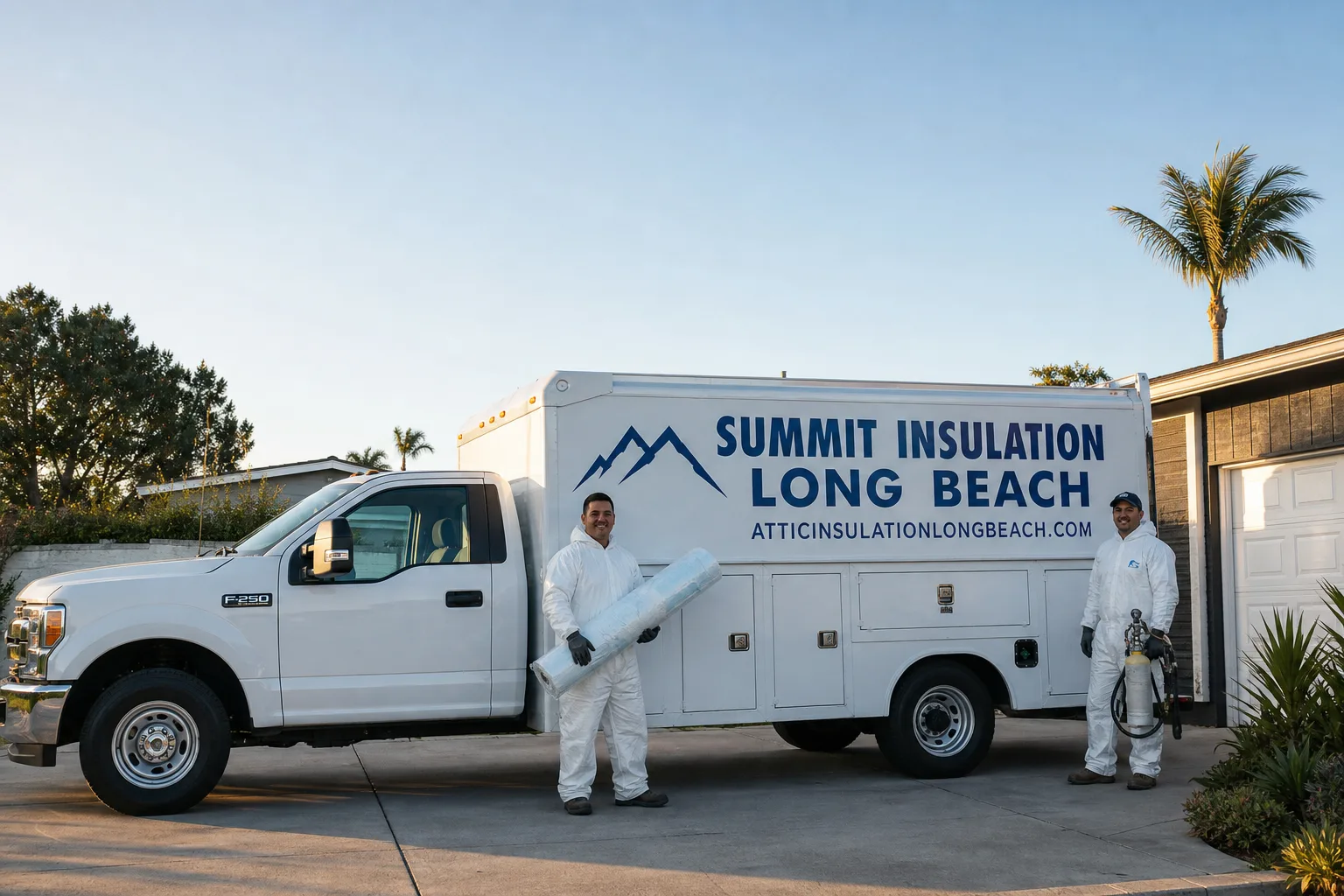
Attic Insulation in Long Beach: What It Costs and What to Expect
Attic insulation in Long Beach typically costs $1.50 to $3.50 per square foot for blown-in fiberglass or cellulose, and $2.50 to $6.00 per square foot for spray foam, depending on your attic’s condition and access. Most homes in neighborhoods like Naples, Bixby Knolls, and Los Altos need a top-up of 6 to 12 inches to meet current R-38/R-60 recommendations for our coastal climate zone, and a full replacement usually takes one day. For a free, no-obligation estimate with an itemized price before any work begins, call Summit Insulation Long Beach at (562) 784-9031. We serve all of Long Beach, Signal Hill, Lakewood, and the surrounding communities.
Trusted Attic Insulation for Long Beach Homeowners
Long Beach attics take a beating. The marine layer rolls in most mornings, and by afternoon the sun is baking your roof deck to well over 130 degrees. That daily swing forces your air conditioner to fight a battle it was never designed to win. If your upstairs rooms feel stuffy by 4 p.m. or your energy bill climbs every July, the problem usually isn’t your HVAC. It’s what’s sitting, or not sitting, above your ceiling. We’ve been into hundreds of Long Beach attics, from Spanish-style homes in California Heights to mid-century ranches in El Dorado Park, and we see the same story: insulation that’s settled, compacted by roof leaks, or chewed through by rodents. Nate Calloway, owner and lead installer at Summit Insulation, handles every attic job personally. That means the person who diagnoses your attic is the same person who installs your insulation. No subcontracted crews, no sales rep promising things the installer never hears about. Call (562) 784-9031 for a same-day assessment.
What Our Attic Insulation Service Includes
Every attic is different, and the right approach depends on what’s already up there, what’s been happening to it, and what your home needs long term. We don’t push one material on every job. We look at your attic floor, your ductwork, your ventilation, and your goals, then match the material and method to the application.
Blown-In Attic Insulation
Blown-in insulation is loose fiberglass or cellulose that gets distributed evenly across your attic floor using a calibrated hose. It’s the most common choice for Long Beach homes because it fills gaps and voids around framing, wiring, and recessed fixtures in a way batts can’t. At Summit Insulation, we measure coverage depth as we go so you hit the R-value you’re paying for, and we use GreenFiber cellulose or Owens Corning fiberglass depending on your attic’s existing material.
Attic Batt Insulation
Batt insulation comes in pre-cut blankets of fiberglass or mineral wool, sized to fit between standard joist spacing. It works well in attics with open, accessible bays and for homeowners who want a clean, uniform look they can see. We install Knauf and Owens Corning batts with care around electrical boxes and plumbing, cutting each piece to fit rather than compressing it into place, because compressed insulation loses R-value fast.
Attic Insulation Top-Up
If your attic already has insulation but it’s below current recommendations, a top-up adds new material directly over the old, raising your R-value without a full removal. This is the most cost-effective option for many Long Beach homes built before the mid-1990s, which typically have only 6 to 8 inches of settled fiberglass. We verify the existing material is dry and free of rodent contamination before we add anything on top, because burying a problem only makes it more expensive later.
Attic Insulation Replacement
When insulation has been soaked by a roof leak, shredded by rats or squirrels, or turned to dust by decades of temperature cycling, the right move is full removal and replacement. We vacuum out the old material, disinfect the attic floor, and install fresh insulation matched to your home’s design. This service pairs naturally with our attic cleaning and rodent proofing work, because new insulation on a contaminated substrate is money thrown away.
Attic Baffles & Ventilation Prep
Insulation that blocks your soffit vents will rot your roof deck and cook your attic. We install baffles at the eaves before adding any insulation, keeping airflow open from the soffits to the ridge or gable vents. Proper ventilation is what prevents the marine-layer moisture that Long Beach gets every morning from condensing inside your attic and feeding mold. This step gets skipped by plenty of low-bid crews, and it’s one of the first things we check.
What happens when you call
- 1
A real person answersNo phone trees — you reach a local pro.
- 2
You get an upfront price rangeHonest numbers before anyone is dispatched.
- 3
A background-checked tech heads outLicensed & insured, dispatched right away.
- 4
You approve before work beginsNothing starts until you say go.
Why Attic Insulation Matters in Long Beach Specifically
Long Beach has its own microclimate. We’re not Riverside, and we’re not Huntington Beach. We get coastal fog that rolls in overnight, burns off by late morning, and leaves behind humidity that can sit in a poorly ventilated attic for weeks. We also get enough sunny 80-degree days in August and September to turn an uninsulated attic into an oven, which radiates heat down into your living space hours after the sun goes down. Homes in the older neighborhoods, Alamitos Beach, Rose Park, Willmore City, were built before modern insulation standards existed. Many have original 2×4 attic joists stuffed with an inch of rock wool from the 1940s. If your home was built before 1980, there’s a good chance your attic is doing almost nothing to slow heat transfer. That means your AC runs longer, your upstairs bedrooms never quite cool down, and your electricity bill reflects it every month.
Signs You Need Attic Insulation Right Now
- Your upstairs rooms are consistently 5 to 10 degrees warmer than downstairs. Heat rises, and when your attic lacks proper insulation or air sealing, that heat radiates down through the ceiling into your bedrooms. This is the number one complaint we hear from Long Beach homeowners with two-story homes in areas like Park Estates and The Plaza.
- Your cooling bill has climbed year over year while your usage habits haven’t changed. SCE rates keep rising, but if your bill jumped 20% or more between recent summers, compromised attic insulation is often the culprit. Your air conditioner is running longer to hit the same thermostat setting.
- You can see the tops of your ceiling joists in the attic. If you pop your head up into the attic and the wooden joists are visible above the insulation, you’re under-insulated. The material should sit well above the joists. In Long Beach, R-38 is the minimum, and R-60 is recommended for homes with central air conditioning.
- You’ve had rodents in the attic, or you hear scratching at night. Rats and squirrels in Long Beach, especially near the San Gabriel River and around trees in neighborhoods like Bluff Heights, burrow through insulation, flatten it, and leave droppings that make existing insulation unsafe. Once they’re inside, the insulation loses virtually all of its thermal performance.
- The second floor gets hot again within an hour of the AC shutting off. Poor attic insulation means the heat load returns almost immediately after the cooling stops. A properly insulated attic keeps that heat out for hours, letting your home maintain a stable temperature with far less cycling.
Our Attic Insulation Process — Step by Step
We don’t show up and start spraying material into an attic we haven’t looked at. Every job starts with a real assessment, and Nate Calloway does the assessment himself. Here’s what to expect.
1. Attic Inspection and Diagnosis
Nate goes up into the attic, not just peeks from the hatch. He checks current insulation depth, looks for signs of moisture, rodent activity, and mold, verifies that bathroom fans and dryer vents are terminating outside, and measures the attic’s square footage and joist spacing. He also checks for air leaks around plumbing penetrations, recessed lights, and the attic hatch itself.
2. Air Sealing Assessment
Insulation slows heat transfer. It does not stop air movement. A completely insulated attic with unsealed top plates and open chases will still leak conditioned air into the attic, pulling in outside air from your crawl space or exterior walls. We seal the gaps and cracks between your living space and attic before adding insulation, because that’s what makes the R-value actually perform.
3. Material Selection and Scope Agreement
We walk you through what we found, what needs to be done, and what it will cost. You get an itemized proposal, not a lump-sum number with no explanation. If the job calls for air sealing, rodent proofing, or vent baffles, those are listed separately so you know exactly what you’re paying for and why it matters.
4. Installation Day
Nate and his team arrive on schedule, protect the work area, and install the insulation to the agreed depth or the batt configuration specified. For blown-in jobs, we use depth markers and a calibrated blower to verify R-value in multiple spots across the attic floor. Edges get attention, not just the middle of the roof. We stay until the job is done properly, not until the clock runs out.
5. Post-Installation Verification
Before we leave, Nate walks the attic with you (or sends photos if you don’t want to climb up) and shows you the finished work. We check coverage depth, confirm ventilation is clear, and make sure the attic hatch is insulated and weather-stripped. You get a written summary of what was installed, the final R-value, and any observations about your attic that could matter down the road, things like roof deck condition or vent placement.
Brands We Work With for Attic Insulation
The reason Summit Insulation carries eight manufacturer lines is simple: no single material is right for every attic. Fiberglass performs differently than cellulose. Open-cell spray foam behaves differently than closed-cell. A 1940s Spanish bungalow in Rose Park has different needs than a brand-new build in Bixby Knolls. We work with Owens Corning and Knauf for fiberglass batts and blown-in fiberglass, GreenFiber for dense-packed cellulose, and Demilec and Icynene for open-cell and closed-cell spray foam. Each material has a specific application where it outperforms the others, and we match that, rather than defaulting to whatever the supply house has on sale that week.
When it comes to spray foam, Icynene open-cell is our go-to for attics that need both insulation and air sealing in a single pass, particularly on the roofline in unconditioned attic conversions. Demilec closed-cell foam is what we recommend for coastal homes in Long Beach where moisture resistance and structural rigidity matter, especially in attic knee walls and cathedral ceilings. Cellulose from GreenFiber works exceptionally well in older homes with irregular joist spacing and lots of penetrations, because it blows in and fills around everything. The point is you get the right material for the application, not the brand our distributor pushes this month.
How Much Does Attic Insulation Cost in Long Beach?
Attic Insulation Near Long Beach — Our Service Area
Summit Insulation Long Beach works throughout the greater Long Beach area, including Signal Hill, Lakewood, Bellflower, Cerritos, Artesia, and Paramount, plus Whittier, Carson, Compton, and Lynwood. Most of our calls come from Long Beach homeowners who found us after getting a quote from a high-pressure generalist. We typically schedule assessments within 48 hours, and for attics that are actively leaking air into the living space or showing signs of rodent intrusion, we make same-week appointments. If you’re in Lakewood, we’re usually 15 minutes away. If you’re across the 710 in Commerce, count on us within 20. We also see a lot of homes in Whittier and Bellflower.
Serving Long Beach, CA — Our Local Coverage Area
We’re based in the Long Beach area and know this community well, offering Attic Insulation — Long Beach homeowners trust. Use the map below to see our service coverage — if you’re nearby, we can almost certainly help.
Frequently Asked Questions — Attic Insulation in Long Beach
What is attic insulation?
Attic insulation is material installed on the attic floor or roofline to slow heat transfer between your living space and the outdoors. In Long Beach, attic insulation keeps the afternoon heat out during summer and holds heated air in during our mild but damp winters. The most common materials are fiberglass batts, blown-in fiberglass or cellulose, and spray foam.
How long does attic insulation take to install?
A standard blown-in top-up or replacement for a 1,000- to 1,500-square-foot attic takes one full day from setup to cleanup. Spray foam jobs and full remediations with rodent cleanup can run two days. We give you a clear timeline before we start, and we don’t leave your attic half-done.
How much does attic insulation cost in Long Beach?
Most Long Beach homeowners spend between $1,200 and $6,500 depending on the scope of work, the type of material, and the condition of the existing attic. A basic blown-in top-up starts around $1,200, while a full removal and replacement plus air sealing runs $3,500 to $6,500. The only accurate number comes from an attic inspection, and ours is free. Call us at (562) 784-9031 for an exact quote.
Do you work with Owens Corning, GreenFiber, Icynene, or Demilec insulation?
Yes. We install Owens Corning fiberglass batts and blown-in fiberglass, GreenFiber cellulose, Icynene open-cell spray foam, and Demilec closed-cell spray foam. We also carry Knauf, Johns Manville, Rockwool, and CertainTeed products. Your attic gets the right material for its specific conditions, not whatever one brand offers.
Do you offer emergency attic insulation service?
If your attic has been compromised by water, rodents, or a fire event, we prioritize your call and can usually be on-site within one to two business days. True same-day emergency work depends on the schedule, but if you’ve had a roof leak and the insulation is soaked, call us at (562) 784-9031 and we’ll do everything we can to get out fast.
Is your attic insulation work warrantied?
Every attic insulation job we install carries the manufacturer’s warranty on the material, and our workmanship is guaranteed in writing. If you find thin spots, settling beyond normal, or any issue with our installation within the warranty period, we come back and make it right. No phone tag, no third-party warranty company.
How should I prepare for attic insulation installation?
Clear any items stored near the attic access point, and let us know if you have any recessed lighting or old wiring we should be aware of. We handle floor protection, and we do a final cleanup with a HEPA vacuum when the job is done. If you have pets, keep them in a closed room during the installation hours. You don’t need to be home the entire time, though Nate will want to walk the finished job with you.
Schedule Your Attic Insulation Service in Long Beach Today
If you’ve been putting up with a hot upstairs, rising energy bills, or the sounds of rodents in your ceiling, don’t wait. Every season that goes by with inadequate insulation costs you money and makes the fix more complicated. Call Summit Insulation Long Beach at (562) 784-9031 to schedule a free attic assessment. Nate Calloway will walk you through what he finds and give you a straight answer about what’s worth doing now. No pressure, no gimmicks, just a clear plan for making your home work the way it should.
Written by Nate Calloway, Owner and Lead Installer at Summit Insulation Long Beach, serving Long Beach and nearby communities. Find Attic Insulation near you with our local team.